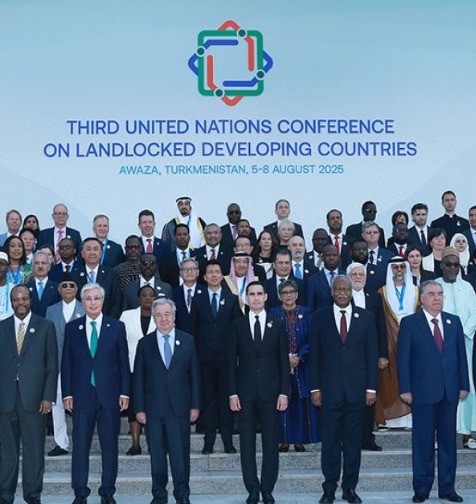
- The third United Nations Conference on Landlocked Developing Countries (LLDC3) has opened in Awaza, Turkmenistan, bringing global focus to the unique development challenges faced by 32 landlocked developing countries (LLDCs), home to over 600 million people.
About the Conference:
- Held once every ten years, the LLDC conference seeks to coordinate international efforts to bridge the development gaps for countries without direct access to seaports.
- This geographic disadvantage creates disproportionate barriers to trade, economic diversification, and infrastructure development.
Theme for 2024:
- "Driving Progress through Partnerships" — the conference aims to create actionable solutions through global partnerships, smarter investment frameworks, and efficient, flexible transport corridors to enhance the movement of goods and services across regions.
Awaza Programme of Action (2024–2034):
- A major outcome of LLDC3 is the implementation of the Awaza Programme of Action (APoA) for the decade 2024–2034.
- Adopted by consensus at the UN General Assembly on 24 December 2024, the APoA provides a comprehensive framework to address persistent development challenges.
Five Interconnected Priority Areas of APoA:
- Structural Transformation, and Science, Technology, and Innovation
- Trade, Trade Facilitation, and Regional Integration
- Transit, Transport, and Connectivity
- Enhancing Adaptive Capacity, Strengthening Resilience, and Reducing Vulnerability
- Implementation, Follow-up, and Monitoring
Significance:
- This conference serves as a crucial platform to mobilize investment, build resilient economies, and ensure inclusive growth for LLDCs through sustainable and collaborative solutions.