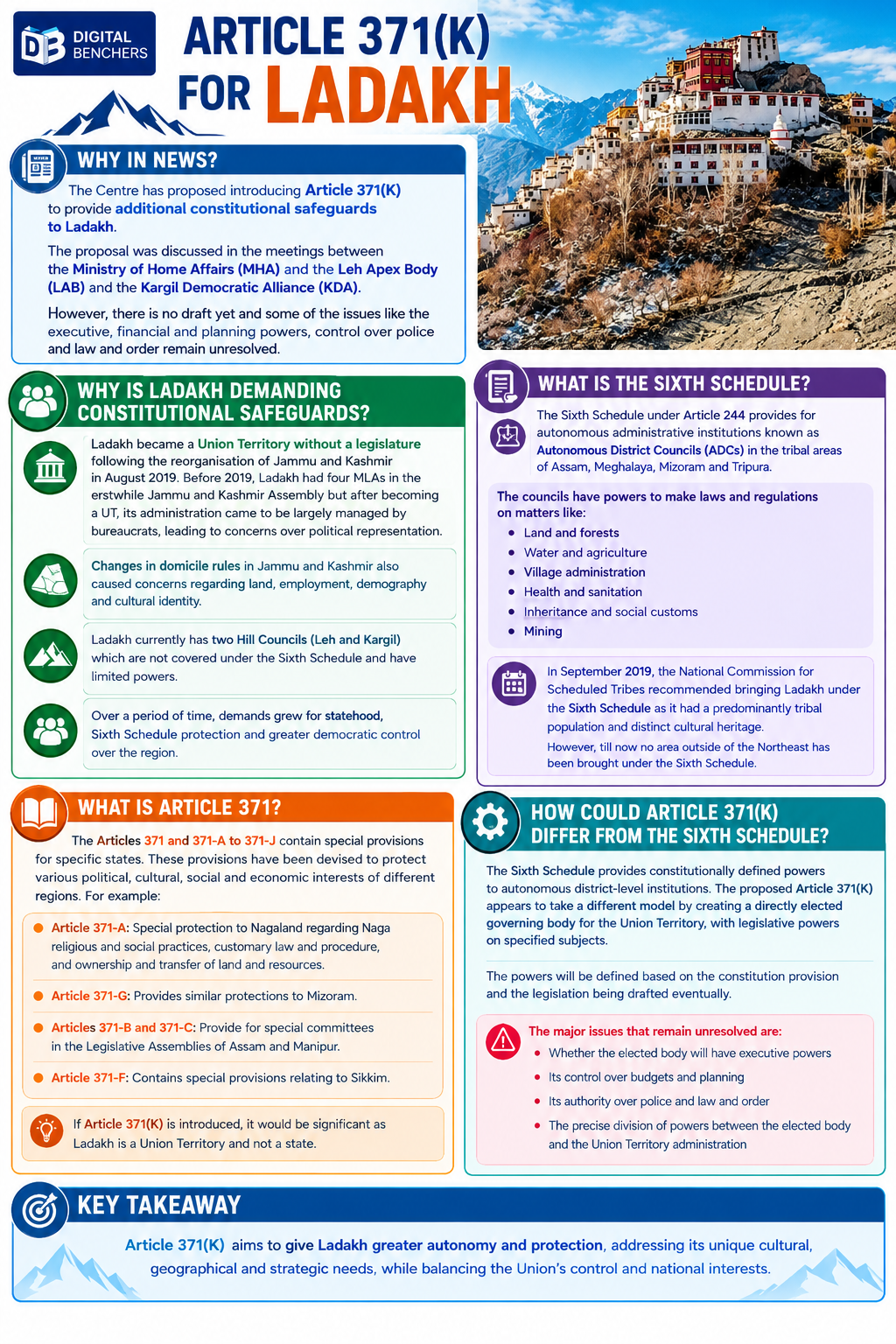
Why in News?
The Centre has proposed introducing Article 371(K) to provide additional constitutional safeguards to Ladakh. The proposal was discussed in the meetings between the Ministry of Home Affairs (MHA) and the Leh Apex Body (LAB) and the Kargil Democratic Alliance (KDA). However, there is no draft yet and some of the issues like the executive, financial and planning powers, control over police and law and order remain unresolved.
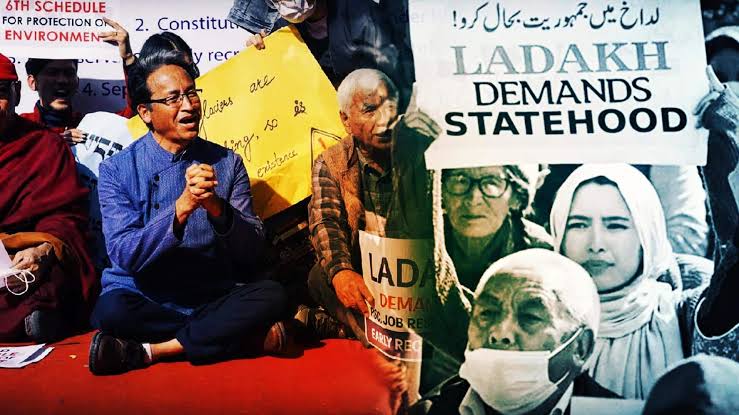
Why is Ladakh Demanding Constitutional Safeguards?
- Ladakh became a Union Territory without a legislature following the reorganisation of Jammu and Kashmir in August 2019. Before 2019, Ladakh had four MLAs in the erstwhile Jammu and Kashmir Assembly but after becoming a UT, its administration came to be largely managed by bureaucrats, leading to concerns over political representation.
- Changes in domicile rules in Jammu and Kashmir also caused concerns regarding land, employment, demography and cultural identity.
- Ladakh currently has two Hill Councils (Leh and Kargil) which are not covered under the Sixth Schedule and have limited powers.
- Over a period of time, demands grew for statehood, Sixth Schedule protection and greater democratic control over the region.
What is the Sixth Schedule?
The Sixth Schedule under Article 244 provides for autonomous administrative institutions known as Autonomous District Councils (ADCs) in the tribal areas of Assam, Meghalaya, Mizoram and Tripura.
The councils have powers to make laws and regulations on matters like:
- Land and forests
- Water and agriculture
- Village administration
- Health and sanitation
- Inheritance and social customs
- Mining
In September 2019, the National Commission for Scheduled Tribes recommended bringing Ladakh under the Sixth Schedule as it had a predominantly tribal population and distinct cultural heritage. However, till now no area outside of the Northeast has been brought under the Sixth Schedule.
What is Article 371?
The Articles 371 and 371-A to 371-J contain special provisions for specific states. These provisions have been devised to protect various political, cultural, social and economic interests of different regions. For example:
- Article 371-A: It provides special protection to Nagaland regarding Naga religious and social practices, customary law and procedure, and ownership and transfer of land and resources.
- Article 371-G: It provides similar protections to Mizoram.
- Articles 371-B and 371-C: These provide for special committees in the Legislative Assemblies of Assam and Manipur.
- Article 371-F: It contains special provisions relating to Sikkim.
If Article 371(K) is introduced, it would be significant as Ladakh is a Union Territory and not a state.
How Could Article 371(K) Differ from the Sixth Schedule?
The Sixth Schedule provides constitutionally defined powers to autonomous district-level institutions. The proposed Article 371(K) appears to take a different model by creating a directly elected governing body for the Union Territory, with legislative powers on specified subjects.
The powers will be defined based on the constitution provision and the legislation being drafted eventually.
The major issues that remain unresolved are:
- Whether the elected body will have executive powers
- Its control over budgets and planning
- Its authority over police and law and order
- The precise division of powers between the elected body and the Union Territory administration