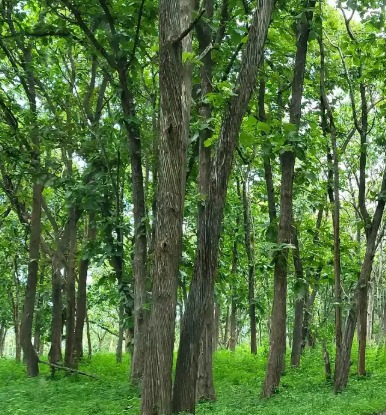
- A recent study by the Institute of Wood Science and Technology (IWST), Bengaluru, has revealed that only 17.2% of the suitable habitat of Indian Rosewood (Dalbergia latifolia) in India is currently within protected areas.
- The finding has raised concerns over the long-term survival of this prized hardwood species, often called the “ivory of the forests,” which is facing threats of overexploitation and lack of natural regeneration.
- Indian Rosewood, scientifically known as Dalbergia sissoo in northern India and Dalbergia latifolia in southern regions, is a fast-growing, hardy, deciduous tree, native to the foothills of the Himalayas, ranging from Afghanistan in the west to Bihar in the east.
- It thrives along river banks above 200 meters and can be found naturally up to 1,400 meters elevation. The tree is noted for its long, leathery leaves, whitish or pink flowers, and distinctive crooked form.
- Rosewood timber is highly valued for its rich grain, deep reddish-brown colour, and exceptional durability, making it a preferred choice for luxury furniture, fine handicrafts, veneers, and musical instruments.
- Beyond its commercial importance, it plays a crucial ecological role, enriching soils through nitrogen fixation, serving as a carbon sink, and supporting bird and insect biodiversity.
- However, researchers have warned that natural populations are increasingly dominated by mature and ageing trees, with little to no regeneration in the wild.
- Seedlings are extremely rare, and in many regions, entirely absent. This raises fears of gradual decline if conservation measures are not urgently strengthened.
- Experts argue that the limited overlap between rosewood’s natural distribution and protected areas increases the risk of habitat loss due to deforestation, agricultural expansion, and unsustainable timber extraction.
- Conservationists have called for stricter protection policies, community-based plantation drives, and habitat restoration to ensure the survival of this ecologically and economically significant species.
Limited-time offerGet up to 75% OFFGrab the offer
Study Finds Only 17% of Indian Rosewood Habitat Lies in Protected Areas
IWST Bengaluru Warns of Poor Regeneration of Dalbergia Species Despite Ecological and Economic Importance
Check your eligibility now