Sawalkote Hydropower Project and India’s Energy Strategy:
- India has reignited the long-stalled Sawalkote Hydropower Project on the Chenab River in Jammu and Kashmir, leveraging the suspension of the Indus Waters Treaty (IWT) with Pakistan in April 2025 following the Pahalgam terror attack.
- This 2,185 MW run-of-the-river project, one of India’s largest, marks a significant step toward energy security and regional development.
Sawalkote Hydropower Project:
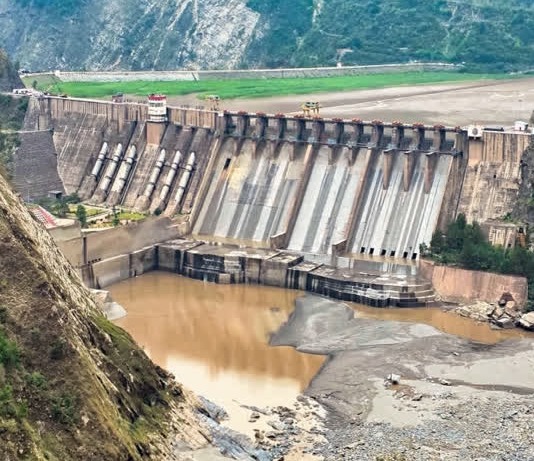
- Location and Scale: A 2,185 MW run-of-the-river hydroelectric plant on the Chenab River in Ramban and Udhampur districts, Jammu and Kashmir, set to be the largest in the Union Territory and among North India’s biggest.
- Infrastructure: Features a 192.5-metre roller-compacted concrete gravity dam, nine turbines, an underground powerhouse, and a reservoir with over 500 million cubic meters capacity.
- Cost and Execution: Estimated at ₹22,704 crore, executed by the National Hydroelectric Power Corporation (NHPC) in collaboration with Jammu and Kashmir State Power Development Corporation (JKSPDC).
- Energy Output: Expected to generate 7,994.73 million units annually, reducing J&K’s winter power shortages and enabling surplus energy export to the national grid.
- Additional Benefits: Facilitates flood mitigation, improves water management for agriculture and domestic use, and boosts local infrastructure through roads, bridges, and housing.
- Timeline and Progress: Conceived in the 1960s, delayed by environmental, administrative, and geopolitical hurdles. Revived with a ₹209.80 crore tender for planning, design, and engineering issued by NHPC on July 29, 2025, with bids due by September 10, 2025. In-principle forest clearance for 847.17 hectares was granted in June 2025.
Indus Waters Treaty (IWT) Context:
- Overview: Signed in 1960 under World Bank mediation, the IWT allocates the Eastern rivers (Ravi, Beas, Sutlej) to India for unrestricted use and the Western rivers (Indus, Jhelum, Chenab) primarily to Pakistan, with India allowed limited non-consumptive uses like hydropower. Pakistan accesses ~70% of the water, India ~30%.
- Dispute Resolution: Includes a three-tier mechanism: Permanent Indus Commission (PIC), Neutral Expert, and Court of Arbitration for unresolved disputes.
- Suspension Impact: India suspended the IWT in April 2025 after the Pahalgam attack, citing Pakistan’s support for terrorism. This removed obligations like prior notification and data-sharing, enabling faster project advancement. India has restricted water flows from existing Chenab dams (Baglihar, Salal), reducing downstream flows by up to 90% at Pakistan’s Marala headworks.
- Geopolitical Shift: The suspension allows India to maximize its use of Western rivers, with Sawalkote as a flagship project to assert water and energy rights, raising concerns in Pakistan about reduced water flows for agriculture and hydropower.
Strategic and Environmental Significance:
- Energy Security: Sawalkote will enhance J&K’s energy independence, align with India’s Paris Agreement climate goals, and support the northern grid’s industrial growth.
- Geopolitical Strategy: The project strengthens India’s position in water diplomacy, countering Pakistan’s objections to Indian projects like Baglihar and Kishanganga.
- Environmental Concerns: The project involves felling ~2.2 lakh trees, with compensatory afforestation planned over 2,115.878 hectares. Local groups highlight risks to Himalayan ecosystems and displacement of 13 villages, requiring robust environmental impact assessments (EIAs) and community compensation.
- Conditions for Progress: The Forest Advisory Committee’s in-principle approval is conditional on dam safety approvals, environmental clearance, and soil conservation plans.
Challenges:
- Environmental Impact: Fragile Himalayan ecosystems and community displacement pose risks, necessitating transparent EIAs and mitigation measures.
- Geopolitical Tensions: Pakistan objects to the project, citing potential disruptions to Chenab flows, and has called for resuming IWT negotiations, accusing India of “weaponizing water.”
- Implementation: Past delays due to bureaucratic hurdles, compensation issues, and an Army camp relocation have been resolved, but timely execution within 113 months remains critical.
- Geopolitics: The IWT suspension and Sawalkote’s revival highlight India’s strategic use of water as leverage in India-Pakistan relations.
- Energy Policy: Aligns with India’s renewable energy goals and J&K’s potential to become power-surplus.
- Environmental Governance: Balancing development with ecological sustainability is a key governance challenge.
- Public Policy: The project’s “national importance” status and integration with regional development (e.g., irrigation, infrastructure) underscore policy priorities.
Conclusion:
- The revival of the Sawalkote Hydropower Project, enabled by the IWT’s suspension, marks a pivotal moment in India’s energy and geopolitical strategy. By harnessing the Chenab River’s potential, India aims to boost J&K’s energy security, support national climate goals, and assert its water rights.
- However, environmental and social challenges require careful management to ensure sustainable development.