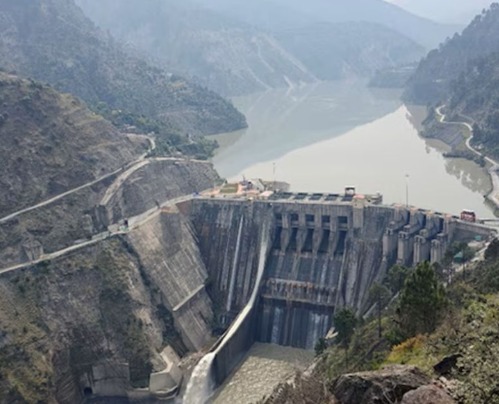
- The long-delayed Sawalkote Dam project on the Chenab River in Jammu and Kashmir has regained momentum as part of India’s renewed hydropower strategy.
- Originally conceived in 1984, the 1,865 MW project is among the largest hydroelectric schemes planned on the western rivers of the Indus basin. Its revival comes in the wake of India suspending the Indus Waters Treaty (IWT) in 2025, following the Pahalgam terror attack.
- The Chenab, traditionally restricted to non-consumptive use under the IWT, is now being tapped for strategic energy generation. The Government of India has declared Sawalkote a priority, with the Ministries of Power and Home Affairs pushing for expedited construction to boost energy security and regional development.
- The Environment Ministry’s Expert Appraisal Committee (EAC) is expected to consider granting environmental clearance. In a controversial move, the Forest Advisory Committee has exempted the project from cumulative impact and carrying capacity studies, citing its pre-2013 origins. This has raised environmental concerns even as it accelerates approvals.
- The dam, a 192.5-metre concrete gravity structure, will create a reservoir with a capacity of 530 million cubic metres, submerging 1,159 hectares of land, including 846 hectares of forest. More than 222,000 trees are expected to be felled across Udhampur, Mahore, Batote, and Ramban districts.
- Critics warn that the Chenab already hosts multiple hydropower projects such as Dulhasti, Baglihar, and Salal, raising questions of ecological stress and outdated impact assessments.
- Despite controversies, Sawalkote is being positioned as a strategic project to enhance India’s hydropower capacity and assert greater control over its western rivers.
Limited-time offerGet up to 75% OFFGrab the offer
Sawalkote Dam Project Revived in Jammu and Kashmir
1,865 MW Hydropower Scheme Gains Momentum After Indus Waters Treaty Suspension
Check your eligibility now