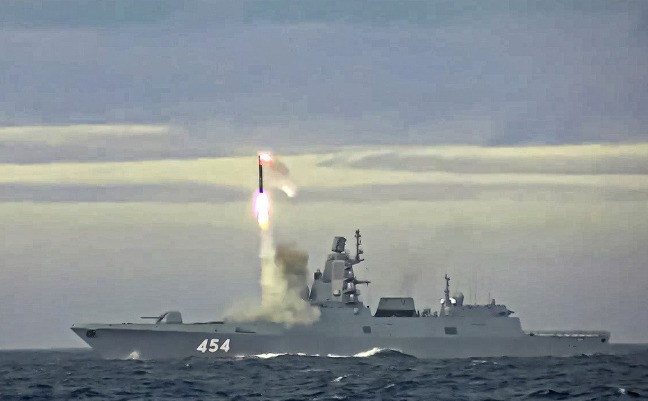
- Russia has announced the successful test-firing of its 3M22 Zircon (Tsirkon) hypersonic cruise missile, claiming it struck a target in the Barents Sea.
- The Zircon, also known by NATO as SS-N-33, is a scramjet-powered maneuvering hypersonic missile that entered service in 2022, initially deployed on Admiral Gorshkov-class frigates.
- Originally designed to target naval assets, it has since evolved to include land-attack capabilities.
- With a length of about 9 meters and weighing up to 4 tons, the missile employs a two-stage propulsion system. A solid-fuel booster first accelerates it to supersonic speeds, after which a scramjet engine ignites, propelling it to hypersonic speeds of up to Mach 9.
- The Zircon has an operational range of 400–450 km at low altitudes, extendable up to 1,000 km in a semi-ballistic trajectory.
- It can carry both conventional and nuclear warheads.
- A notable feature of the Zircon is its ability to generate a plasma cloud during hypersonic flight, a phenomenon known as plasma stealth, which makes radar detection extremely difficult.
Limited-time offerGet up to 75% OFFGrab the offer
Russia Test-Fires Zircon Hypersonic Missile in Barents Sea
Scramjet-Powered 3M22 Zircon Capable of Reaching Mach 9 and Evading Radar
Check your eligibility now