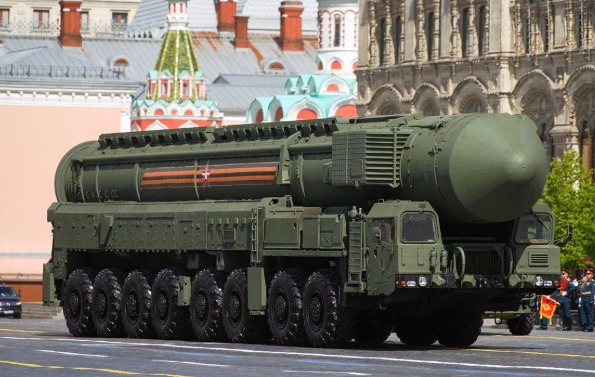
- As tensions escalate between the United States and Russia, global attention has once again shifted to one of the most formidable weapons in Russia’s nuclear arsenal — the RS-28 Sarmat Intercontinental Ballistic Missile (ICBM), also referred to by NATO as ‘Satan II’.
About RS-28 Sarmat:
- The RS-28 Sarmat is a new generation ICBM developed by Russia, designed to enhance its strategic deterrence capabilities.
- It is named after the ancient Sarmatian people of the 4th and 5th centuries BC.
- In the West, it is widely known as “Satan II” due to its destructive potential.
Salient Features:
- Type: Three-stage, liquid-fueled intercontinental ballistic missile.
- Range: Up to 18,000 km, making it capable of striking any point on the globe.
- Launch Weight: Over 208 tonnes, making it the world’s heaviest ICBM.
- Dimensions: Approximately 35.3 meters in length and 3 meters in diameter.
- Speed: Achieves a maximum speed of 25,500 kph (approx. Mach 20).
- Payload Capacity: Can carry up to 10 tonnes.
- Warhead Options:
- Can be equipped with up to 16 independently targetable nuclear warheads.
- Capable of carrying Avangard hypersonic glide vehicles.
- Guidance Systems:
- Inertial navigation,
- GLONASS (Russia’s GNSS),
- Astro-inertial navigation technology, allowing precise targeting
Technological Edge – Fractional Orbital Bombardment:
- The RS-28 Sarmat is believed to support fractional orbital bombardment capability.
- This involves launching the missile into low Earth orbit, possibly in the opposite direction to the intended target, making detection and interception by missile defense systems extremely difficult.
Destructive Capability:
- According to reports, the missile can deliver nuclear warheads up to 2,000 times more powerful than the atomic bombs dropped on Hiroshima and Nagasaki in 1945.
- The RS-28 Sarmat highlights critical issues in nuclear deterrence, global security, arms race, and technological advancements in missile systems.
- It is significant in the context of Russia’s military strategy, NATO responses, and India’s national security environment.