Why in News?
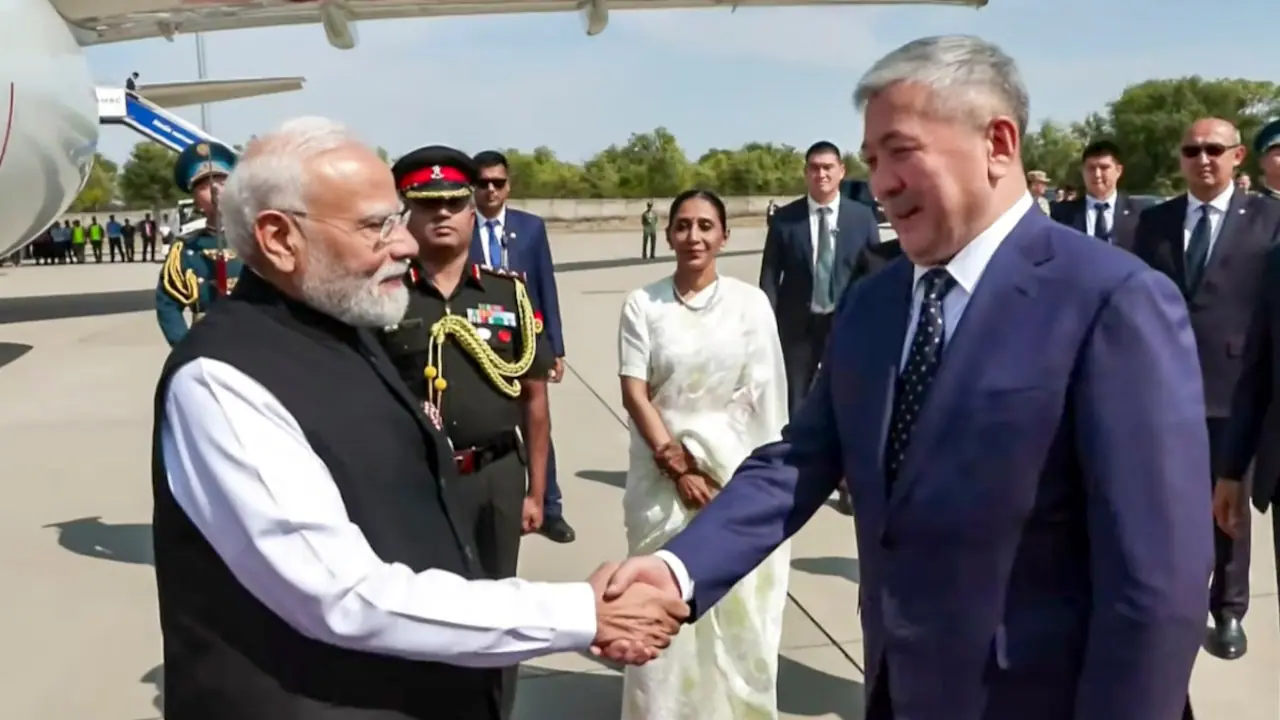
Prime Minister Narendra Modi presented a range of Indian cultural artefacts to the leaders of Uzbekistan and Kyrgyzstan during his recent visit to the two Central Asian countries.
The gifts highlighted India’s rich traditions in literature, music, textiles, handicrafts and tea, while also reflecting cultural similarities between India and the two Central Asian nations.
Gifts to Kyrgyzstan
President Sadyr Japarov
- A 10-volume English translation of the Mahabharata by Bibek Debroy.
- A traditional Ladakhi Tsug-dul blanket, known for its colourful geometric and floral patterns and made from locally sourced wool.
The Mahabharata has particular cultural relevance in Kyrgyzstan because of its parallels with the Epic of Manas. Both epics preserve stories, values and collective memory across generations.
The Tsug-dul blanket also reflects similarities between the pastoral and nomadic traditions of Ladakh and Kyrgyzstan.
Prime Minister Adylbek Kasymaliev
- A Dokra artwork depicting a pair of traditional musicians.
- The artwork uses India’s traditional lost-wax metal-casting technique and highlights the importance of folk music in preserving cultural traditions.
Gifts to Uzbekistan
President Shavkat Mirziyoyev
- A sandalwood Shata Tantri Veena (Santoor) associated with the musical traditions of Jammu and Kashmir. Its form has similarities with Uzbekistan’s traditional Chang instrument.
- Two boxes of premium Kangra tea — Kangra First Flush Black Tea and Kangra Green Tea.
- An original handwritten chess scoresheet of Grandmaster Javokhir Sindarov from the 2025 FIDE World Cup final in Goa.
Mirziyoyev’s family
- His wife received a marble-inlay casket with a Banarasi silk stole, combining Agra’s marble craftsmanship with Varanasi’s silk-weaving tradition.
- His daughter received a fine silver floral brooch featuring traditional craftsmanship.
Uzbekistan Prime Minister Abdulla Aripov
- A marble-inlay decorative plate featuring floral and foliate designs.
Significance
These gifts go beyond ceremonial exchanges and represent India’s cultural diplomacy with Central Asia.
They showcase:
- India’s literary heritage through the Mahabharata.
- Himalayan and pastoral traditions through the Tsug-dul blanket.
- Traditional performing arts through the Dokra musicians and Santoor.
- Craft traditions through marble inlay, Banarasi silk and silverwork.
- India’s agricultural heritage through Kangra tea.
- Growing cultural links through chess diplomacy.