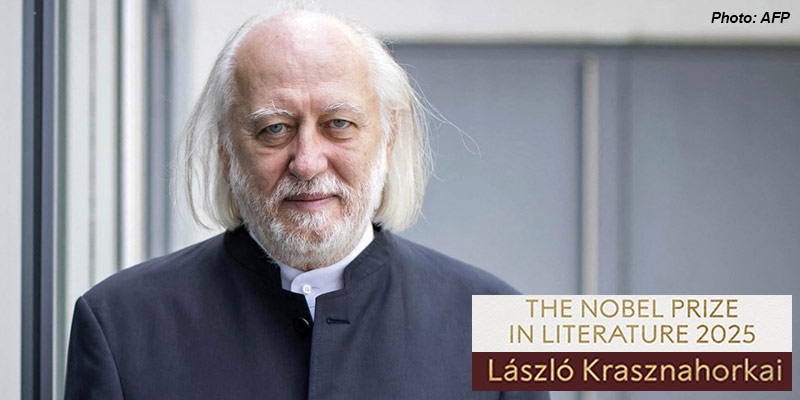
- The Royal Swedish Academy of Sciences announced on 9 October 2025 that the Nobel Prize in Literature for the year has been awarded to Hungarian author László Krasznahorkai. The award recognises his compelling and visionary body of work that explores themes of apocalyptic terror while affirming the enduring power of art.
- रॉयल स्वीडिश एकेडमी ऑफ साइंसेज़ ने 9 अक्टूबर 2025 को घोषणा की कि इस वर्ष का साहित्य का नोबेल पुरस्कार हंगरी के लेखक लास्लो क्रास्नाहोर्काई को दिया गया है। यह पुरस्कार उनकी गहन और दूरदर्शी रचनाओं के लिए दिया गया है, जो प्रलयकारी भय जैसे विषयों को कला की स्थायी शक्ति के साथ जोड़ती हैं।
- The Nobel Prize in Literature is part of the annual Nobel Prize announcements. Recently, the Literature Prize followed those in Physiology or Medicine, Physics, and Chemistry announced earlier in the week. The Peace Prize and the Prize in Economic Sciences are scheduled for announcement later in October. Each Nobel Prize carries a cash award of 11 million Swedish kronor, equivalent to approximately ₹1.03 crore. The awards ceremony takes place on 10 December, the anniversary of Alfred Nobel’s death.
- साहित्य का नोबेल पुरस्कार वार्षिक नोबेल घोषणाओं का हिस्सा है। इस सप्ताह पहले घोषित फिजियोलॉजी या मेडिसिन, भौतिकी और रसायन विज्ञान के पुरस्कारों के बाद साहित्य का पुरस्कार घोषित किया गया। शांति पुरस्कार और अर्थशास्त्र का पुरस्कार अक्टूबर के अंत में घोषित किए जाएंगे। प्रत्येक नोबेल पुरस्कार के साथ 1.1 करोड़ स्वीडिश क्रोनर (लगभग ₹1.03 करोड़) की धनराशि दी जाती है। पुरस्कार समारोह 10 दिसंबर को, अल्फ्रेड नोबेल की पुण्यतिथि पर आयोजित किया जाएगा।
- László Krasznahorkai’s Literary Journey
- लास्लो क्रास्नाहोर्काई की साहित्यिक यात्रा
- Born in 1954 near the Romanian border, Krasznahorkai emerged as a literary sensation in Hungary with his debut novel Sátántangó (1985), which gained international acclaim with its English translation in 2012. His works are known for their dense prose and apocalyptic themes. Krasznahorkai’s novels often blend despair with beauty, exploring human existence under extreme conditions.
- 1954 में रोमानियाई सीमा के पास जन्मे क्रास्नाहोर्काई ने अपनी पहली उपन्यास सातान्तांगो (1985) के साथ हंगरी में साहित्यिक ख्याति प्राप्त की, जिसका अंग्रेज़ी अनुवाद 2012 में अंतरराष्ट्रीय प्रशंसा का कारण बना। उनकी रचनाएँ गहन भाषा शैली और प्रलयकारी विषयों के लिए जानी जाती हैं। उनके उपन्यास अक्सर निराशा और सुंदरता का मिश्रण करते हैं, और मानव अस्तित्व को कठिन परिस्थितियों में परखते हैं।
- Key Works and Themes
- प्रमुख रचनाएँ और विषय
- Among his notable works is Herscht 07769 (2025), hailed as a contemporary German novel. It portrays social unrest in a small town in Thüringen, Germany, intertwining violence and beauty against the backdrop of Johann Sebastian Bach’s legacy.
- उनकी प्रमुख रचनाओं में Herscht 07769 (2025) शामिल है, जिसे एक आधुनिक जर्मन उपन्यास के रूप में सराहा गया है। यह जर्मनी के थ्यूरिंगेन के एक छोटे शहर में सामाजिक अशांति को दर्शाता है, जहाँ हिंसा और सुंदरता, जोहान सेबास्टियन बाख की विरासत के संदर्भ में गुँथे हुए हैं।
- Another important work is Északról hegy, Délről tó, Nyugatról utak, Keletről folyó (2022), translated as A Mountain to the North, a Lake to the South, Paths to the West, a River to the East. Additionally, Seiobo járt odalent (2008; Seiobo There Below, 2013) is a collection of 17 stories arranged according to the Fibonacci sequence, reflecting on beauty and artistic creation amid impermanence and blindness.
- एक अन्य प्रमुख रचना Északról hegy, Délről tó, Nyugatról utak, Keletről folyó (2022) है, जिसका अनुवाद A Mountain to the North, a Lake to the South, Paths to the West, a River to the East के रूप में किया गया है। इसके अलावा, Seiobo járt odalent(2008; Seiobo There Below, 2013) 17 कहानियों का संग्रह है, जो फिबोनाची अनुक्रम में व्यवस्थित हैं और अस्थिरता व अंधकार के बीच सुंदरता और कला सृजन पर विचार करती हैं।
- Significance of the Award
- पुरस्कार का महत्व
- The Nobel Committee praised Krasznahorkai for his ability to combine apocalyptic terror with a reaffirmation of art’s power. His works challenge readers to confront chaos while recognising the transcendent nature of creativity. The award continues the Nobel tradition of honouring literature that contributes deeply to human understanding and culture.
- नोबेल समिति ने क्रास्नाहोर्काई की इस क्षमता की सराहना की कि वे प्रलयकारी भय को कला की पुनर्स्थापित शक्ति के साथ जोड़ते हैं। उनकी रचनाएँ पाठकों को अराजकता का सामना करने के लिए प्रेरित करती हैं, जबकि रचनात्मकता की आध्यात्मिक प्रकृति को स्वीकार करती हैं। यह पुरस्कार उस नोबेल परंपरा को आगे बढ़ाता है, जो मानव समझ और संस्कृति में गहराई से योगदान देने वाले साहित्य को सम्मानित करती है।
- Background of the Nobel Prize
- नोबेल पुरस्कार की पृष्ठभूमि
- The Nobel Prize was established by Alfred Nobel, a Swedish inventor, who in his will directed that his fortune be used to reward those who confer the greatest benefit to humankind annually. Since 1901, the Nobel Prizes have recognised outstanding achievements in Physics, Chemistry, Physiology or Medicine, Literature, Peace, and Economic Sciences.
- नोबेल पुरस्कार की स्थापना स्वीडिश वैज्ञानिक अल्फ्रेड नोबेल ने की थी, जिन्होंने अपनी वसीयत में यह निर्देश दिया था कि उनकी संपत्ति का उपयोग हर वर्ष मानवता के कल्याण के लिए असाधारण योगदान देने वालों को पुरस्कृत करने में किया जाए। 1901 से अब तक, नोबेल पुरस्कार भौतिकी, रसायन विज्ञान, शरीर विज्ञान या चिकित्सा, साहित्य, शांति और अर्थशास्त्र के क्षेत्रों में उत्कृष्ट उपलब्धियों को सम्मानित करता आ रहा है।
Limited-time offerGet up to 75% OFFGrab the offer
Nobel Prize in Literature 2025 Awarded to László Krasznahorkai
The Royal Swedish Academy of Sciences announced on 9 October 2025 that the Nobel Prize in Literature
Check your eligibility now