Why is it in the news?
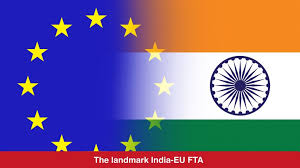
→ India and the European Union concluded negotiations for a comprehensive Free Trade Agreement.
→ The agreement marks a major shift in economic relations and now moves to legal scrubbing, translation and ratification.
Category
IR
Important Points
- The EU committed to open 97% of tariff lines, covering 99.5% of India’s exports by value.
- Labour-intensive sectors (textiles, apparel, leather, footwear, marine products, gems & jewellery, toys, sports goods) enter the EU at zero duty; current EU duties were 4–26%.
- Zero-duty access covers exports worth about USD 33 billion.
- The EU made binding commitments across 144 services subsectors including IT/ITeS, digital, professional, education and business services.
- Preferential access provided for Indian agricultural and processed food exports to the EU.
- India committed market access on 92.1% tariff lines covering 97.5% of EU exports.
- Sensitive sectors (dairy, cereals, poultry, soymeal and select agriculture) remain protected; automobiles, wines and spirits to be gradually liberalised.
- India opened 102 services subsectors including telecom, financial, maritime, environmental and business services.
- MSME-friendly rules of origin allow self-certification through Statements of Origin; special flexibilities for shrimps, prawns and downstream aluminium.
- Balanced IPR framework remains TRIPS-compliant, protects generic pharma and recognises Traditional Knowledge Digital Library.
- FTA advances the China-plus-one strategy and creates a rules-based “zone of trust” for semiconductors, AI, defence manufacturing and green technologies.
- India–EU together represent ~25% of global GDP and one-third of global trade.
- EU is India’s largest goods trading partner (USD 135 billion in FY 2023–24); services trade USD 53 billion in 2023; EU investments exceed USD 117 billion.
- Key challenges highlighted: CBAM (20–35% equivalent tax on steel from 2026), EUDR, CSDDD, asymmetry in tariffs, competition from zero-duty countries.