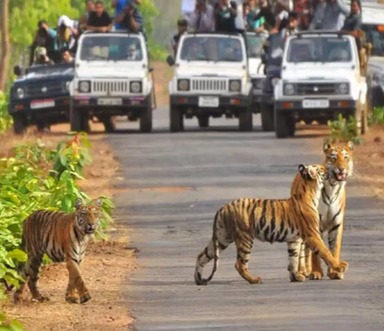
- The National Green Tribunal (NGT) has recently criticised the Madhya Pradesh government for permitting the annual Darshan Yatra inside the core zone of the Bandhavgarh Tiger Reserve.
- The tribunal raised concerns that such activities could harm the fragile ecosystem and disturb the thriving tiger population in the reserve, which holds the highest density of tigers in India and the world.
- Bandhavgarh Tiger Reserve, located in the Umaria district of Madhya Pradesh, spans an area of 1,536 sq. km., including 716 sq. km. of core zone and 820 sq. km. of buffer zone.
- Nestled in the Satpura and Vindhya mountain ranges, the reserve derives its name from the historic Bandhavgarh Fort, believed to have been gifted by Lord Rama to his brother Lakshmana, symbolising “Bandhavgarh” or “Brother’s Fort.”
- The reserve is not only known for its tiger population but also for its archaeological significance.
- It features around 39 caves with Pali inscriptions, depictions of animals, and ancient monuments such as stupas and statues dating back to the 1st century BCE.
- The landscape is diverse, marked by valleys, hills, and plains, with the Bandhavgarh Fort as a striking landmark.
- The flora of Bandhavgarh comprises dense Sal forests, mixed vegetation, and open grasslands. Its rich fauna includes tigers, leopards, sloth bears, Indian bison (gaur), Asiatic elephants, and several deer species like sambar and chital.
- The NGT’s intervention highlights the need to balance cultural traditions with ecological preservation, ensuring that tourism and religious events do not threaten the biodiversity of one of India’s most vital tiger habitats.
Limited-time offerGet up to 75% OFFGrab the offer
National Green Tribunal Pulls Up Madhya Pradesh Over Darshan Yatra in Bandhavgarh Tiger Reserve
Concerns Raised Over Tourism Activities in Core Zone of Tiger Habitat
Check your eligibility now