Why in News?
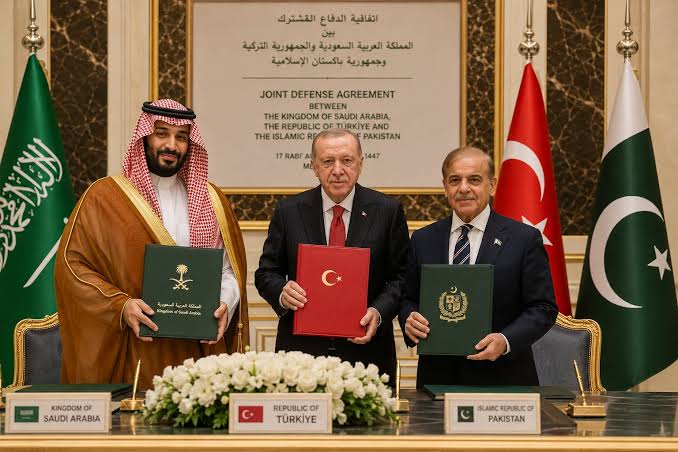
Saudi Arabia, Pakistan and Türkiye signed the Mecca Joint Defence Agreement in Mecca on 7 August 2026.
About the Agreement
- The agreement was signed by the Crown Prince of Saudi Arabia, Mohammed bin Salman, the President of Turkey, Recep Tayyip Erdogan, and the Prime Minister of Pakistan, Shehbaz Sharif.
- The deal comes after nearly a year of consultations between the three countries.
- It is believed to be defensive in nature as it does not explicitly identify any country as a target.
- The agreement does not state out what military support each nation would give if the other was attacked.
- Saudi authorities stated the agreement did not seek to create a military alliance or sectarian bloc that would fuel nuclear blackmail or an arms race.
Strategic Significance
- Saudi Arabia is a major oil exporter and hosts Islam’s two holiest sites.
- Türkiye has NATO’s second-largest military, while Pakistan is the only nuclear-armed Muslim-majority country.
- The three countries already have significant defence ties. Pakistan has provided military training and technical assistance to Saudi Arabia, while Türkiye and Pakistan cooperate in areas such as naval and air-force training.
- Saudi Arabia is also a major buyer of Turkish drones.
- The agreement comes amid heightened regional tensions, including attacks involving Iran, Israel and other regional actors, which have affected Gulf security, energy supplies and shipping routes.
- It also reflects growing concerns in Saudi Arabia about the reliability of its traditional U.S. security umbrella.
India’s Position
- India is closely following the development, the foreign ministry noted. The deal is strategically significant for India, the foreign ministry said, noting that Pakistan and Türkiye are important regional security actors and Saudi Arabia is a key energy and economic partner for New Delhi.
Significance
The Mecca Joint Defence Agreement marks a significant step towards greater regional security cooperation among Saudi Arabia, Pakistan and Türkiye, while potentially contributing to the emergence of a more regionally driven security architecture in West Asia.