Mahabodhi Temple:
- The Mahabodhi Temple at Bodh Gaya, Bihar, regarded as the site of Buddha’s Enlightenment, is once again in national focus.
- The Supreme Court has agreed to examine a petition seeking to repeal the Bodh Gaya Temple Act, 1949, and introduce a central law for improved administration and protection of the site.
Why in News?
- The Supreme Court of India has agreed to hear a petition challenging the Bodh Gaya Temple Act, 1949.
- The plea advocates for replacing the Act with a central legislation to ensure better governance and representation in managing the Mahabodhi Temple.
- Concerns have been raised over religious representation and control, as the current Act allows a Hindu majority in the temple management committee of a Buddhist religious site.
About the Mahabodhi Temple:
- One of the four most sacred Buddhist pilgrimage sites, the others being
- Lumbini – Birthplace of Buddha
- Sarnath – First sermon
- Kushinagar – Parinirvana (final liberation)
- Location: Bodh Gaya, Bihar, on the banks of the Niranjana (Phalgu) River.
Historical Background:
- The first temple was built by Mauryan Emperor Ashoka in the 3rd century BCE.
- The current structure dates back to the 5th–6th century CE, built during the Gupta period.
- Heavily restored in the 19th century
- Burmese Buddhists
- British archaeologist Sir Alexander Cunningham
- Declared a UNESCO World Heritage Site in 2002.
Architectural Features:
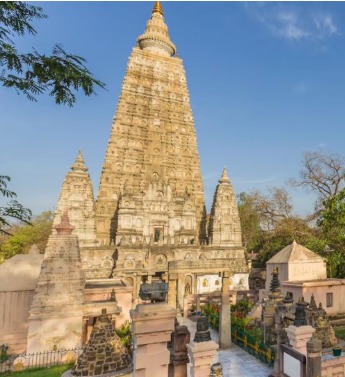
- Main Temple Height: 180 feet (55 meters), with a pyramid-shaped central tower (shikhara).
- Surrounding Structures:
- Four smaller corner towers identical in design to the central tower.
- Vajrasana (Diamond Throne):
- A stone platform marking the exact spot of Buddha’s Enlightenment.
- Sacred Bodhi Tree:
- Believed to be a direct descendant of the original Bodhi tree.
- Buddha Statue:
- Yellow sandstone image encased in glass inside the main shrine.
Stone Railings & Ashoka Pillar:
- Intricate railings and one of Ashoka’s inscribed pillars enhance the site's historic value.