
Why in News?
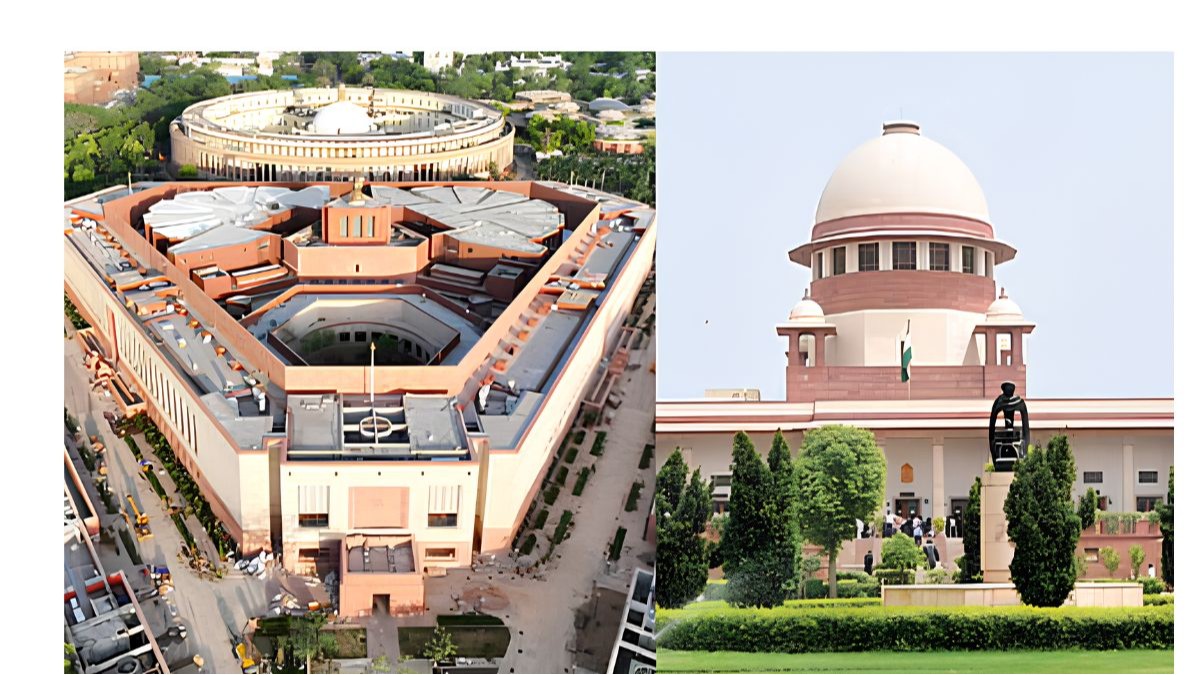
The Lok Sabha has passed the Supreme Court (Number of Judges) Amendment Bill, 2026, raising the sanctioned strength of Supreme Court judges from 34 to 38 (including the Chief Justice).
Importance
- It should help speed up the clearing of pending cases.
- Forming Constitution Benches becomes easier.
- It strengthens the judiciary's efficiency and timely access to justice.
Key Highlights
- This Bill replaces the earlier Supreme Court (Number of Judges) Amendment Ordinance, 2026.
- With the new amendment, the Supreme Court can now have up to 38 judges in total, including the Chief Justice.
- According to the government 92,101 cases were pending in the Supreme Court as of 1 January 2026.
- More judges should help both in clearing the backlog and in setting up Constitution Benches on a more regular basis.
- Union Law Minister Arjun Ram Meghwal introduced the Bill in the Lok Sabha.
- Amid opposition protests the Bill was passed by voice vote without discussion.
About Supreme Court
- The Supreme Court, which is India's apex court was established on January 28, 1950.
- Article 124 deals with the establishment, composition and appointment of judges of the Supreme Court.
- Parliament can change the number of Supreme Court judges through an ordinary law.
- The Supreme Court interprets the Constitution, protects fundamental rights, and settles disputes between the Centre and states.
- In 2019, the number of judges was raised to 34 (including the CJI); it now stands at 38.
Static Facts
- Article 32 is called the "heart and soul" of the Constitution, since it lets citizens approach the Supreme Court directly to protect their fundamental rights.
- The Supreme Court exercises original, appellate, advisory and writ jurisdiction.
- Under Article 136, the Supreme Court has the power to accept Special Leave Petitions (SLPs).
- As per Article 141, Supreme Court judgments are binding on all courts across the country.
- Article 142 empowers the Supreme Court to pass any order necessary to ensure "Complete Justice."