
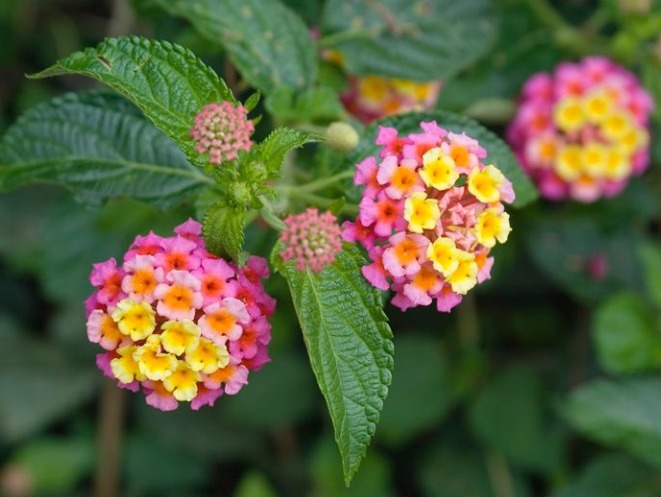
- Lantana camara, an invasive alien plant species, has spread rapidly across Himachal Pradesh, threatening the State's rich forest biodiversity.
- It now covers over 3.25 lakh hectares, forming dense, unproductive thickets and displacing native plant species.
- Despite control efforts, experts warn that faster, ecosystem-based approaches are needed to curb its spread.
1. Background and Spread:
- Origin: Native to Central and South America, introduced in India in the 18th century as an ornamental plant.
- Spread in Himachal: Found in seven forest territorial circles — Dharamshala, Nahan, Hamirpur, Chamba, Bilaspur, Mandi, and Shimla.
- Extent: As per the India State of Forest Report 2023, Lantana covers approx. 3,252.82 sq. km of forest land.
2. Ecological Impact:
- Forms dense thickets along forest edges, particularly in areas with sparse canopy.
- Releases allelochemicals, which suppress the growth of native flora.
- Leads to the decline in plant diversity and disrupts local ecosystems, creating homogeneous vegetation that reduces habitat quality.
3. Control Measures Undertaken:
- Since 2009–10, around 51,000 hectares have been cleared using the 'cut root stock' method, where plants are severed at the root to prevent regrowth.
- Replantation with native species follows clearance to restore ecological balance.
- The Forest Department aims to eradicate 1,000 hectares annually under this program.
4. Challenges and Recommendations:
- Spread to higher elevations is a major concern, necessitating early action in those zones.
- Experts call for a multi-stakeholder approach, involving:
- Local communities
- NGOs and civil society
- Government agencies
- Such collaboration can also generate livelihoods tied to lantana biomass utilisation.
5. Utilisation of Lantana Biomass:
- Furniture and fuelwood: Lantana wood is durable and useful in rural applications.
- Organic compost: Converted into manure to support organic farming.
- Pharmaceutical use: Contains alkaloids with medicinal potential.
- Creating value from lantana biomass could incentivise its removal.
6. Prevention and Policy Directions:
- Ban on cultivation near highways, gardens, and public landscaping.
- Emphasis on:
- Prevention
- Early detection
- Rapid eradication
- Need for time-bound, location-specific action plans with community participation for long-term success.
- The Lantana invasion in Himachal Pradesh is an urgent ecological challenge. Sustained, integrated efforts combining control, community involvement, and biomass utilisation are essential to protect native biodiversity and preserve forest ecosystems.