
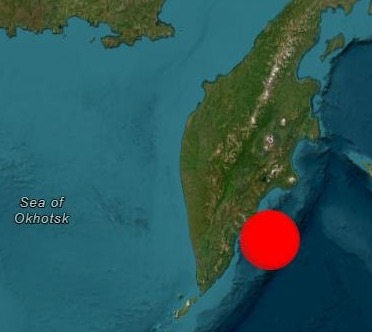
- On July 2025, the Kamchatka Peninsula in eastern Russia experienced a series of strong earthquakes, with the most powerful reaching magnitude 7.4.
- These quakes occurred near the eastern coastline—an area renowned for frequent seismic and volcanic activity.
- Tsunami warnings were issued but later cancelled, as no abnormal waves were observed.
- No major casualties or structural damages were reported, but the incident highlighted the ongoing geological risks in this remote region.
Geological Significance:
- Kamchatka lies at the convergent boundary of the Pacific Plate and the North American Plate, making it a major seismic and volcanic hotspot.
- 127 volcanoes, with 22 currently active
- Klyuchevskaya Sopka, the tallest active volcano in Eurasia (4,750 metres)
- Since 1900, the region has witnessed at least 7 major quakes exceeding magnitude 8.3.
Historical Earthquakes in Kamchatka:
- 1952 Kamchatka Earthquake:
- Magnitude 9.0, one of the largest recorded globally
- Triggered 30-foot tsunami waves, which reached as far as Hawaii
- Despite the size, there were no reported fatalities
- The region remains under constant seismic surveillance due to its history of powerful quakes and tsunamis.
Geography and Climate:
- Length: ~1,200 km; Width: ~480 km
- Bordered by the Sea of Okhotsk (west) and Pacific Ocean (east)
- Dominated by two volcanic mountain chains running parallel to each other
Climate:
- Cold, snowy winters; cool, short summers
- Vegetation includes tundra, birch, and larch forests
Human and Economic Aspects:
- Capital & Largest City: Petropavlovsk-Kamchatsky
- Ethnic Composition: Predominantly Russians, with indigenous communities like the Koryaks and Chukchi
Economy:
- Fishing industry (especially crab) is central
- Limited agriculture due to harsh climate
- Reindeer and cattle herding practiced by locals
- Small-scale use of geothermal energy near southern Kamchatka