Why in News?
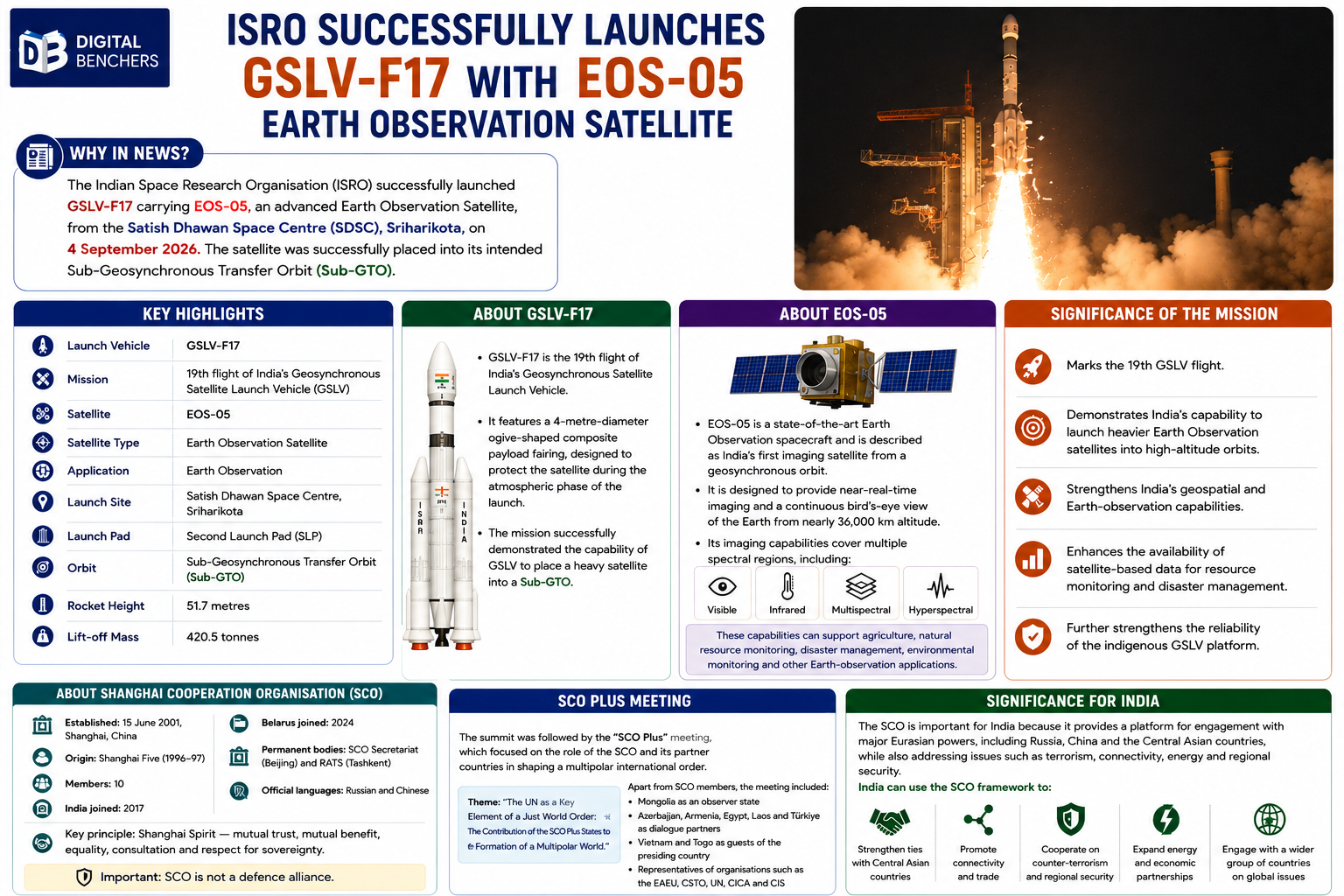
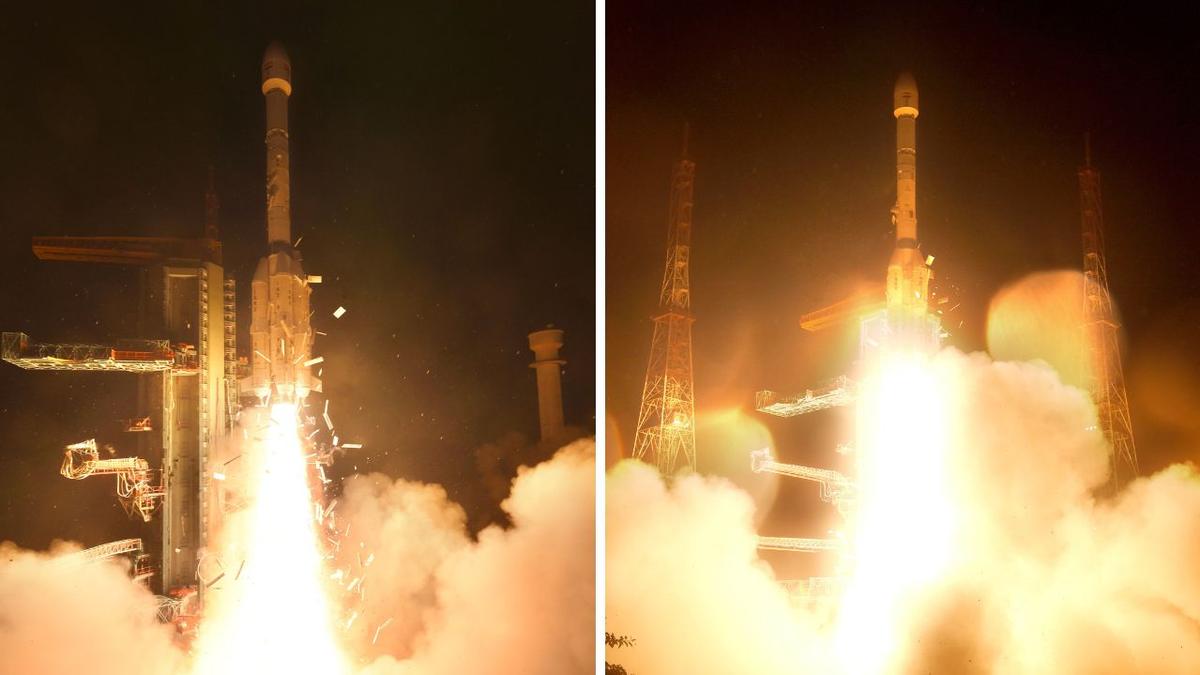
The Indian Space Research Organisation (ISRO) successfully launched GSLV-F17 carrying EOS-05, an advanced Earth Observation Satellite, from the Satish Dhawan Space Centre (SDSC), Sriharikota, on 4 September 2026. The satellite was successfully placed into its intended Sub-Geosynchronous Transfer Orbit (Sub-GTO).
Key Highlights
- Launch Vehicle: GSLV-F17
- Mission: 19th flight of India’s Geosynchronous Satellite Launch Vehicle (GSLV)
- Satellite: EOS-05
- Satellite Type: Earth Observation Satellite
- Application: Earth Observation
- Launch Site: Satish Dhawan Space Centre, Sriharikota
- Launch Pad: Second Launch Pad (SLP)
- Orbit: Sub-Geosynchronous Transfer Orbit (Sub-GTO)
- Rocket Height: 51.7 metres
- Lift-off Mass: 420.5 tonnes
About GSLV-F17
- GSLV-F17 is the 19th flight of India’s Geosynchronous Satellite Launch Vehicle. It features a 4-metre-diameter ogive-shaped composite payload fairing, designed to protect the satellite during the atmospheric phase of the launch.
- The mission successfully demonstrated the capability of GSLV to place a heavy satellite into a Sub-GTO.
About EOS-05
- EOS-05 is a state-of-the-art Earth Observation spacecraft and is described as India’s first imaging satellite from a geosynchronous orbit.
- It is designed to provide near-real-time imaging and a continuous bird’s-eye view of the Earth from nearly 36,000 km altitude.
Its imaging capabilities cover multiple spectral regions, including:
- Visible
- Infrared
- Multispectral
- Hyperspectral
- These capabilities can support agriculture, natural resource monitoring, disaster management, environmental monitoring and other Earth-observation applications.
Significance of the Mission
- Marks the 19th GSLV flight. Demonstrates India’s capability to launch heavier Earth Observation satellites into high-altitude orbits.
- Strengthens India’s geospatial and Earth-observation capabilities.
- Enhances the availability of satellite-based data for resource monitoring and disaster management.
- Further strengthens the reliability of the indigenous GSLV platform.