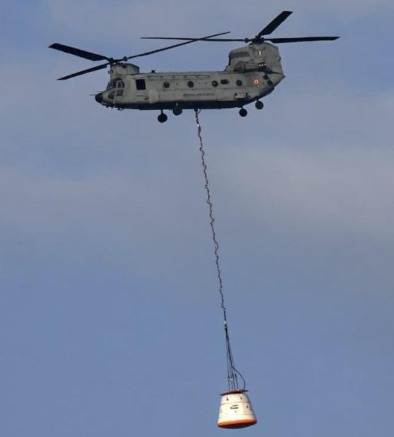
- The Indian Space Research Organisation (ISRO) has successfully carried out its first Integrated Air Drop Test (IADT-1) for the Gaganyaan mission, India’s first human spaceflight program.
- The test aimed to validate the performance of the parachute-based deceleration system for the Crew Module (CM) under real-world conditions.
- The test involved a collaborative effort with the Defence Research and Development Organisation (DRDO), Indian Air Force, Indian Navy, and Indian Coast Guard.
About Gaganyaan Mission:
- Overview: India’s inaugural human spaceflight mission intends to send 3 astronauts to Low Earth Orbit (LEO) at 400 km for 3 days and return them safely.
- Mission Phases: Includes unmanned test missions followed by the first manned mission, expected in early 2027.
- Significance: A successful mission will make India one of the elite nations—US, Russia, China—with human spaceflight capability.
Crew Training:
- Designated astronauts include Group Captain Prasanth Balakrishnan Nair, Group Captain Ajit Krishnan, Group Captain Angad Pratap, and Wing Commander Shubhanshu Shukla.
- Human-Rated Launch Vehicle (HLVM3): Modified LVM3 rocket capable of carrying the Orbital Module to LEO. Equipped with Crew Escape System (CES) for safe aborts during launch or ascent.
- Orbital Module (OM): Houses the Crew Module (CM) and Service Module (SM). CM is pressurized and habitable, while SM supports thermal, propulsion, and power systems.
Mission Preparatory Tests:
- Integrated Air Drop Test (IADT): Validates parachute and deceleration systems.
- Test Vehicle Missions (TV): Test abort and launch systems.
- Pad Abort Test (PAT): Checks crew module safety at different altitudes.
- Water Survival Test Facility (WSTF): Recovery exercises with Navy support.
- The successful IADT-1 marks a critical step toward ensuring crew safety and advancing India’s journey in human spaceflight.