Latest Development:
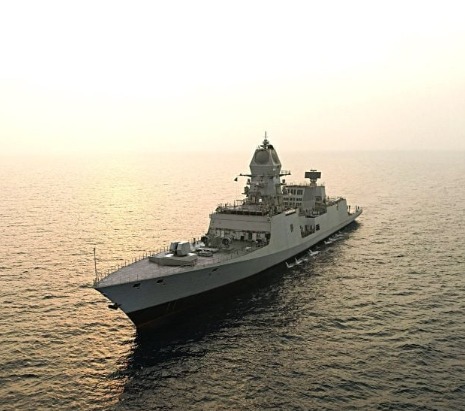
- On July 31, 2025, INS Himgiri (Yard 3022) was formally delivered to the Indian Navy by Garden Reach Shipbuilders & Engineers (GRSE) in Kolkata.
- It is the third frigate under Project 17A (Nilgiri-class) and the first of the class constructed by GRSE, a leading defence PSU shipyard.
Background and Historical Significance:
- INS Himgiri is a namesake of the erstwhile INS Himgiri, a Leander-class frigate that served the Navy for three decades before being decommissioned on 6 May 2005.
- The project reflects the Indian Navy’s tradition of reviving legacy ships with modern capabilities, blending history with advanced engineering.
Project 17A (Nilgiri-class) Overview:
- Project 17A is an advanced follow-on to the earlier Project 17 (Shivalik-class).
- A total of seven stealth frigates are being constructed under P17A
- Four by Mazagon Dock Shipbuilders Ltd. (MDL) in Mumbai.
- Three by GRSE, Kolkata.
Design and Construction:
- Designed indigenously by the Warship Design Bureau (WDB).
- Supervised by the Warship Overseeing Team (Kolkata).
- Built using modular construction technology, enhancing build efficiency and precision.
- Integrated 3D digital modelling and virtual reality tools for design validation.
Advanced Features and Capabilities:
- Stealth Features: Optimized hull and superstructure for reduced radar, infrared, and acoustic signatures.
Propulsion System:
- CODOG (Combined Diesel or Gas) configuration.
- Includes gas turbines for high-speed and diesel engines for cruising, each driving Controllable Pitch Propellers (CPP).
Weapon and Sensor Suite:
- Supersonic Surface-to-Surface Missiles (likely BrahMos).
- Medium-Range Surface-to-Air Missiles (MRSAM).
- Close-in Weapon System (CIWS) for point defence.
- Indigenous Combat Management System (CMS).
Integrated Platform Management System (IPMS):
- Centralized control of propulsion, auxiliary systems, power management, and damage control.
Aviation Facility:
- Flight deck and hangar for multi-role helicopters (such as MH-60R or HAL Dhruv).
Indigenous Content and Industrial Participation:
- Over 75% indigenous content by cost, showcasing India's growing defence industrial base.
- More than 200 MSMEs and local industries involved, supporting Atmanirbhar Bharat.
- Integration of locally developed electronics, propulsion systems, and hull materials.
Strategic and National Importance:
- Enhances Indian Navy’s blue water capability, especially in the Indo-Pacific region.
- Symbol of India’s advancement in indigenous shipbuilding and maritime combat technology.
- Reinforces India’s role as a regional maritime power and net security provider.
- Strengthens export potential, with India aiming to become a global hub for defence shipbuilding.
Looking Ahead:
- The remaining P17A ships are at various stages of construction and trials.
- The delivery of INS Himgiri is expected to be followed soon by other vessels, boosting fleet modernization.
- Project 17A ships are a precursor to future indigenous destroyers and frigates being conceptualized.