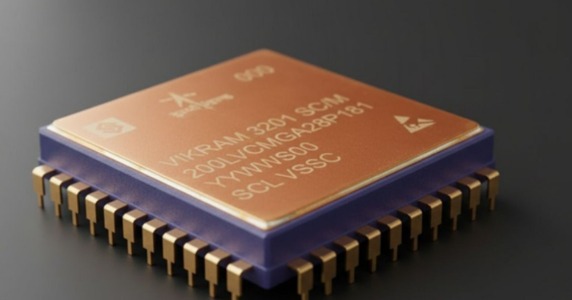
- India has announced the successful development of the Vikram 3201, its first fully indigenous 32-bit microprocessor designed for space applications.
- The chip, developed by the Indian Space Research Organisation (ISRO) in collaboration with the Semiconductor Laboratory (SCL), Chandigarh, represents a significant stride toward technological self-reliance in the strategically vital semiconductor sector.
- Built to withstand the extreme conditions of outer space, the processor is set to play a crucial role in powering critical avionics systems in launch vehicles and satellites.
- The Vikram 3201 is a dedicated space-grade semiconductor microprocessor engineered to function reliably in the punishing environment of space, including exposure to high radiation, extreme temperatures, and intense vibration.
- It is the successor to the Vikram 1601, a 16-bit chip that has been used by ISRO since 2009, and marks a leap in both performance and resilience.
- Technically, the microprocessor is based on a 32-bit architecture, allowing it to handle more complex computations with greater precision.
- It supports 64-bit floating-point operations, which are essential for tasks such as trajectory calculations and real-time guidance during space missions. Another notable feature is its compatibility with the Ada programming language, which is widely adopted in aerospace systems for its safety and reliability.
- In addition, the chip incorporates on-chip 1553B bus interfaces, enabling smooth communication with other avionics modules.
- Fabricated using 180-nanometre CMOS technology, the Vikram 3201 strikes a balance between reliability and performance, ensuring that it meets the demanding standards of space operations.
- Its robustness was validated during the PSLV-C60 mission, where it successfully powered the Mission Management Computer on the PSLV Orbital Experimental Module (POEM-4). This in-orbit demonstration confirmed both its functional capabilities and its resilience to space conditions.
- The first production batches of Vikram 3201 were delivered to ISRO in early 2025, signaling readiness for deployment in upcoming missions.
- With this breakthrough, India joins a select group of nations capable of designing and fabricating advanced microprocessors for space applications, a development that not only strengthens national security but also enhances India’s independence in critical technology domains.
Limited-time offerGet up to 75% OFFGrab the offer
India Unveils Vikram 3201, Its First Indigenous 32-Bit Space Microprocessor
ISRO and SCL develop advanced processor to power launch vehicles, marking a milestone in semiconductor self-reliance
Check your eligibility now