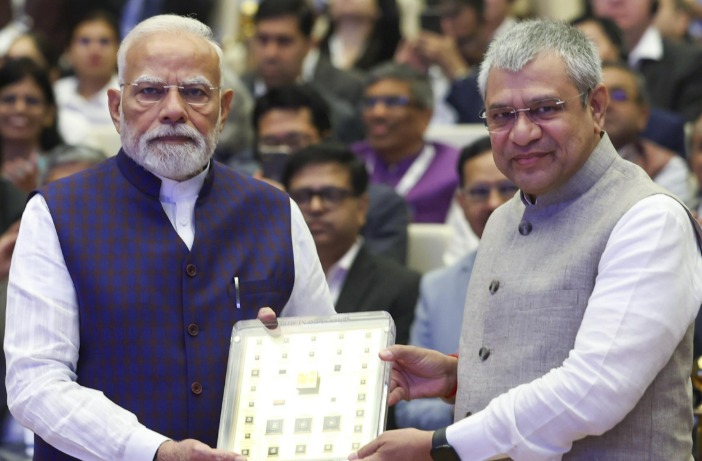
- At the Semicon India 2025 conference, India unveiled its first fully indigenous 32-bit microprocessor, the Vikram 3201, marking a major technological milestone for the country’s space programme.
- Developed by the Vikram Sarabhai Space Centre (VSSC) and fabricated at ISRO’s Semiconductor Laboratory (SCL) in Chandigarh, the processor is built specifically for rockets and satellites, unlike commercial processors used in smartphones or laptops.
- The new chip is an advanced upgrade to Vikram 1601, the 16-bit processor that has powered ISRO’s launch vehicles since 2009.
- The Vikram 3201 is designed to perform critical functions such as navigation, control, and mission management in launch vehicles, executing rapid calculations needed to keep rockets stable and on course.
- Built to withstand the extreme challenges of space, it can operate in temperatures ranging from –55°C to +125°C while enduring radiation, vibration, and pressure variations. The processor supports 64-bit floating-point operations, is compatible with the Ada programming language, and integrates on-chip 1553B bus interfaces for secure and reliable communication during missions.
- With its ability to handle greater memory and complex instructions, the Vikram 3201 represents India’s leap toward self-reliance in space-grade semiconductor technology and promises to enhance the efficiency and reliability of future satellite launches and space exploration missions.
Limited-time offerGet up to 75% OFFGrab the offer
India Unveils Vikram 3201, First Fully Indigenous 32-Bit Microprocessor for Space Missions
Designed by VSSC and Built at ISRO’s Semiconductor Lab, the Processor Will Power Future Launch Vehicles and Satellites
Check your eligibility now