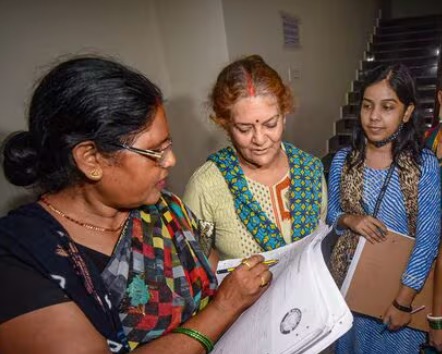
- The Census of India 2027 will be the nation’s first fully digital exercise, transforming how demographic data is collected and processed.
- Nearly 34 lakh enumerators will use their personal smartphones with upgraded mobile applications, reducing the need for government-supplied hardware.
- The apps will support English, Hindi, and regional languages, ensuring wide accessibility, while citizens will also be able to self-enumerate through a web portal.
- The Census will be conducted in two phases—houselisting from April to September 2026, followed by population enumeration in February 2027 across most states.
- In Ladakh, Jammu & Kashmir, Himachal Pradesh, and Uttarakhand, enumeration will begin in September 2026 due to weather conditions.
- For the first time, every residential and non-residential building will be geo-tagged using Digital Layout Mapping (DLM), linking latitude-longitude coordinates to Houselisting Blocks (HLBs) on GIS maps.
- This innovation will improve accuracy, planning, and spatial analysis for urban and rural development.
- To ensure efficiency, the Registrar General of India, under the Ministry of Home Affairs, is developing a real-time monitoring dashboard to track progress nationwide.
- If data is collected on paper in exceptional cases, it must be entered into the web portal, eliminating duplication or scanning delays.
- The government has allocated Rs 14,618.95 crore for the exercise, underlining its scale and importance. While the 2011 Socio-Economic Caste Census had used electronic devices supplied by Bharat Electronics Limited, the 2027 Census represents a leap forward by relying on personal smartphones, modern apps, and self-enumeration facilities, making it the most advanced census in India’s history.
Limited-time offerGet up to 75% OFFGrab the offer
India to Conduct First Fully Digital Census in 2027
Smartphone apps, geo-tagging, and real-time monitoring to modernise population data collection
Check your eligibility now