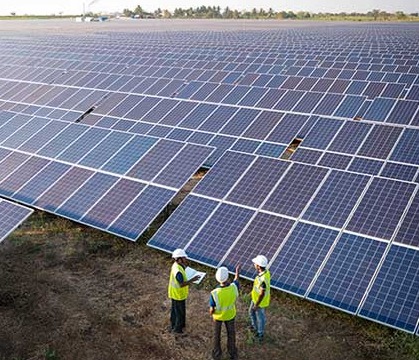
- India has set 2028 as the target year to achieve complete domestic manufacturing of solar modules, cells, wafers, and ingots under its Swadeshi Solar Cells plan.
- The initiative, led by the Ministry of New and Renewable Energy (MNRE), is backed by Production-Linked Incentive (PLI) schemes, GST cuts, and policy reforms to strengthen the domestic solar value chain.
- The primary objectives are to reduce dependence on imported—especially Chinese—solar components, enhance energy security, make India a global solar manufacturing hub, and generate employment opportunities.
- The plan also seeks to attract investment, leveraging the Rs 24,000 crore PLI scheme and foreign direct investment in the renewable energy sector.
- India has already achieved 100 GW of solar module capacity and now plans expansion to upstream components.
- The PLI scheme has attracted Rs 50,000 crore worth of investment and created more than 12,600 direct jobs.
- Complementary government schemes like the Surya Ghar Muft Bijli Yojana have benefitted 2 million households (with 50% reporting zero electricity bills), while the PM-KUSUM scheme has enabled the installation/solarisation of 1.6 million solar pumps, saving 1.3 billion litres of diesel annually.
- Policy measures like the GST reduction from 12% to 5%, single-window clearances, and fast-track land allotment are further accelerating project execution.
- By 2028, India aims to secure its place as a major player in the global solar supply chain while simultaneously promoting Atmanirbhar Bharat and climate goals.
Limited-time offerGet up to 75% OFFGrab the offer
India Targets 2028 for Swadeshi Solar Cells
National mission to achieve full domestic solar manufacturing and reduce import dependence
Check your eligibility now