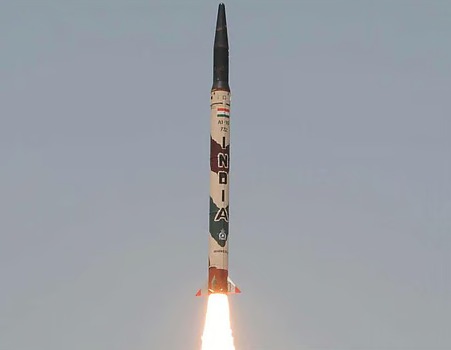
- India reaffirmed its growing strategic capabilities with the recent successful test-firing of two nuclear-capable short-range ballistic missiles—Prithvi-II and Agni-I—from the Integrated Test Range off the coast of Odisha. These tests are not merely routine technical drills but reflect the country’s continued commitment to strengthening its deterrence posture and indigenous defence development.
- The Prithvi-II missile, with a range of approximately 350 kilometers, is a vital component of India’s short-range ballistic missile arsenal. Designed to carry both nuclear and conventional warheads weighing up to 500 kg, the missile successfully demonstrated its operational effectiveness and reliability. With its quick launch capabilities and high precision, Prithvi-II plays a crucial role in India’s tactical battlefield preparedness.
- Likewise, the Agni-I, developed under the Integrated Guided Missile Development Programme (IGMDP), remains a formidable asset in India’s arsenal. With a range extending to 700–900 kilometers, Agni-I fills the gap between short-range and intermediate-range capabilities, offering a flexible response option in regional security dynamics.
- In a parallel development, India also tested the Akash Prime missile in the high-altitude terrain of Ladakh. This surface-to-air missile, an upgraded version of the original Akash system, demonstrated its capability in extreme weather and terrain, especially significant given its deployment potential near the Line of Actual Control (LAC) with China. The Akash Prime test underscores India's focus on strengthening its air defence in sensitive border zones and reducing reliance on imported systems.
- Together, these tests serve as a message of strategic clarity. While India maintains a no-first-use nuclear doctrine, these advances emphasize preparedness and resilience. As regional tensions simmer and new-age warfare evolves, maintaining a credible deterrent backed by indigenous technology becomes not just a strategic necessity but a symbol of national strength.
- In essence, these missile trials reflect not just technical milestones, but a broader narrative of self-reliance, deterrence, and India's rising role in shaping regional security architecture.