
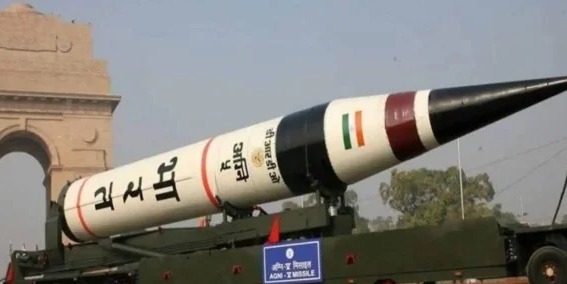
- India has demonstrated a significant advancement in its strategic defense capabilities with the successful test-fire of the Agni-5 intermediate-range ballistic missile from the Integrated Test Range. Developed indigenously by the Defence Research and Development Organisation (DRDO), the Agni-5 is among the most advanced surface-to-surface nuclear-capable ballistic missiles in India’s arsenal.
Key Features of Agni-5
- Range: Exceeds 5,000 kilometers, putting it in the intercontinental ballistic missile (ICBM) category capable of reaching strategic targets far beyond the subcontinent.
- MIRV Capability: Equipped with Multiple Independently Targetable Reentry Vehicles (MIRV), allowing it to carry and deploy up to three nuclear warheads simultaneously, enhancing strike precision and deterrence impact.
- Advanced Technologies: Incorporates state-of-the-art navigation, guidance, warhead, and propulsion systems to optimize accuracy and reliability.
Understanding Ballistic Missiles
- Ballistic missiles like Agni-5 are rocket-propelled systems that deliver payloads via a high-arching trajectory from launch points to predetermined targets.
- They may carry conventional, chemical, biological, or nuclear munitions and launch from land, air, sea, or submarine platforms.
Strategic Impact
- The successful test-firing of Agni-5 underscores India’s growing technological prowess and cements its defensive deterrence by providing a credible second-strike capability with precision targeting and extended reach.
- It plays a critical role in maintaining strategic stability and protecting national security interests.