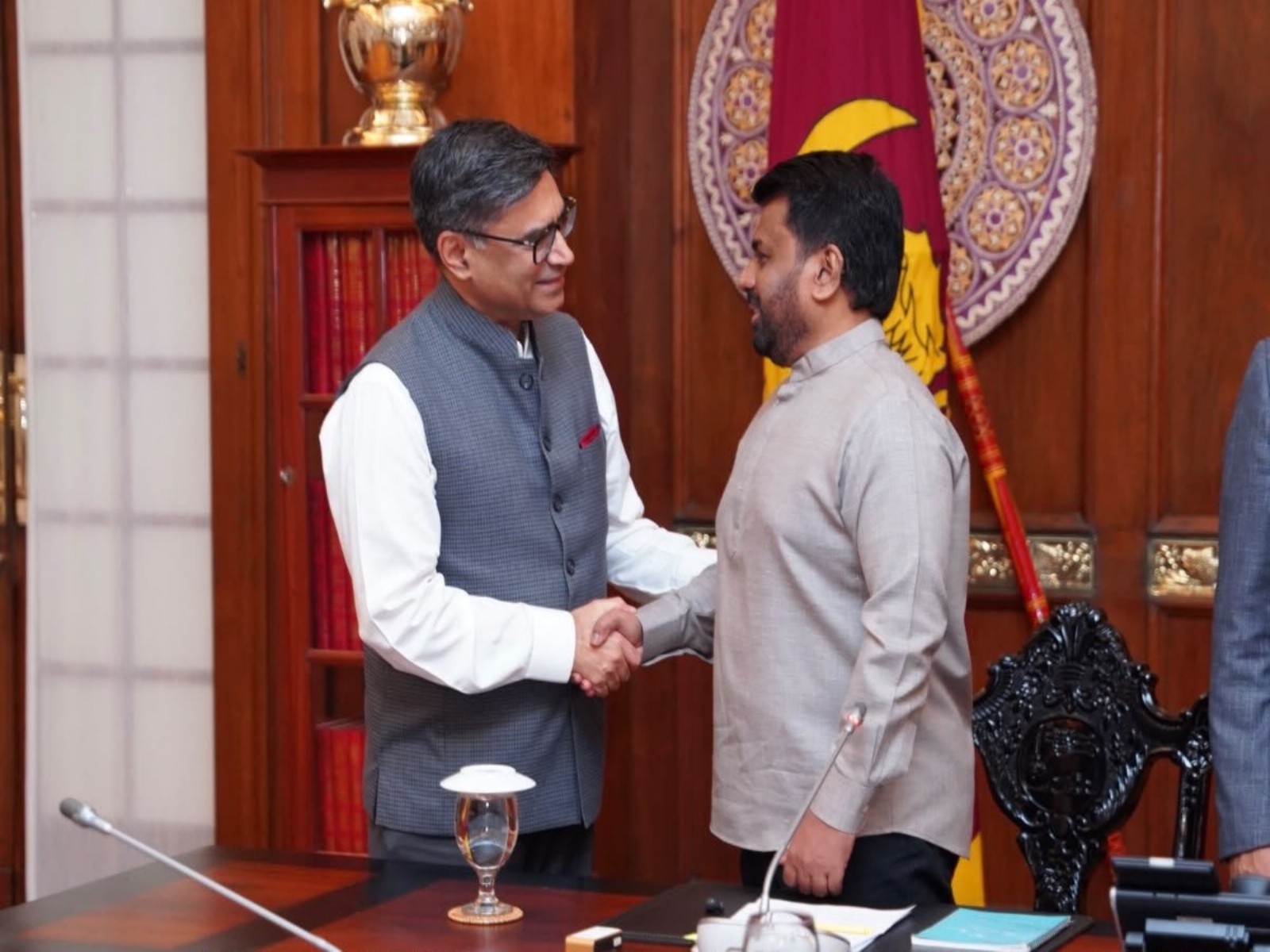
Why in News
- Foreign Secretary Shri Vikram Misri paid an official visit to Sri Lanka. It was his first stand-alone visit to Sri Lanka as Foreign Secretary.
Key Highlights
Reconstruction and Development
- Both sides reviewed progress under the USD 450 million reconstruction package announced following Cyclone Ditwah.
- Agreements were exchanged for two INR-denominated Lines of Credit: USD 250 million for railway projects, USD 100 million for livestock and other priority requirements.
- Reconstruction of damaged houses and construction of permanent bridges under a USD 100 million grant are expected to begin shortly.
- India is also supporting the supply of medical equipment, medical kiosks and educational equipment.
- Work on the Northern Railway corridor, supported by a USD 5 million grant, has been completed and train services have resumed.
Energy and Connectivity Cooperation
- Both sides discussed expediting major energy projects, including: Electricity Grid Interconnection, Sampur Solar Power Project
- Development of Trincomalee as an energy hub
- India and Sri Lanka agreed to expedite the Sri Lanka Unique Digital Identity Project.
- Discussions will begin on an MoU for the rehabilitation and modernisation of Kankesanthurai Harbour, supported by a USD 61.5 million Indian grant.
- Both sides also agreed to work towards expanding the 1990 Suwa Seriya Ambulance Service.
Economic Cooperation
- India and Sri Lanka agreed to take forward negotiations to update the India–Sri Lanka Free Trade Agreement (FTA).
- Negotiations on the India–Sri Lanka Social Security Agreement have been successfully concluded, with signing expected after completion of internal procedures.
- India’s capacity-building initiative has benefited more than 1,000 Sri Lankan professionals across different sectors during its first year.
Community and Tamil Issues
- India urged Sri Lanka to accelerate implementation of projects for the Indian Origin Tamil (IOT) community.
- This includes the construction of 10,000 houses for IOTs, announced during Prime Minister Narendra Modi’s 2017 visit to Sri Lanka.
- India also called for the early conduct of Provincial Council elections and full implementation of Sri Lanka’s constitutional provisions to address the aspirations of the Tamil community.
Fishermen Issue
- The issue of Indian fishermen and detained fishing boats was also discussed.
- India sought Sri Lanka’s cooperation for their early release.
- India emphasised that a humanitarian approach, considering the livelihood concerns of fishermen, should guide the resolution of the issue.
Strategic Significance
- Sri Lanka is strategically important for India because of its location in the Indian Ocean and its relevance to India’s maritime security and regional connectivity.
- Sri Lankan President Anura Kumara Disanayaka had earlier assured that Sri Lankan territory would not be permitted to be used in any manner inimical to India’s security.
- The visit reinforces India’s efforts to strengthen a comprehensive development and strategic partnership with Sri Lanka based on mutual security, economic growth and regional stability.
Importance
- Strengthens India’s “Neighbourhood First” policy as well as Vision MAHASAGAR.
- Positions India as a key external player in post-war Sri Lanka.
- Facilitates greater cooperation on energy, rail, ports and digital connectivity.
- Offers to address the welfare and developmental needs of the Tamil and Indian-Origin Tamil communities.
- Manages sensitivities over fishermen and maritime security.
- Provides strategic outreach and deeper engagement in the Indian Ocean Region.
About Palk Strait
- Location: A narrow strait separating Tamil Nadu (India) from the Mannar District of Sri Lanka's Northern Province, connecting the Bay of Bengal (northeast) with the Gulf of Mannar and Palk Bay (southwest).
- Width: Approximately 64–137 km wide at different points (one of the narrower international maritime boundaries in the world).
- Named after: Robert Palk, a former British Governor of Madras (18th century).