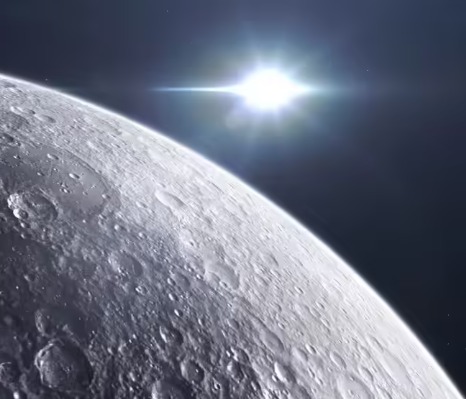
- Scientists at the Raman Research Institute (RRI), Bengaluru, have proposed a groundbreaking lunar mission named PRATUSH, aimed at unlocking the mysteries of the Cosmic Dawn.
- The telescope, to be sited on the Moon’s far side, is designed to probe one of the most important phases in the Universe’s history—the era of reionization.
- PRATUSH stands for Probing ReionizATion of the Universe using Signal from Hydrogen.
- Developed by RRI with active collaboration from the Indian Space Research Organisation (ISRO), the mission features a wideband frequency-independent antenna operating in the 30–250 MHz range, a self-calibratable analog receiver, and a digital correlator with high spectral resolution.
- The telescope will observe large regions of the sky continuously, recording spectra of radio emissions with a fine spectral resolution of 100 kHz.
- The mission’s nominal lifetime is set at two years, allowing sufficient sky coverage and a high signal-to-noise ratio. Its preferred orbit is a circumlunar trajectory, enabling uninterrupted measurements of the radio sky spectrum from the dark and far side of the Moon—an environment shielded from Earth-based radio interference.
- A distinctive innovation in PRATUSH’s design lies in its modest yet powerful control system—a compact single-board computer (SBC), initially based on Raspberry Pi. This SBC serves as the master controller for the radiometer system, managing the antenna, overseeing the analog receiver, and controlling the Field Programmable Gate Array (FPGA) that converts signals into digital fingerprints.
- It also records high-speed data streams, conducts preliminary data processing, and ensures calibration.
- By harnessing cutting-edge but cost-effective technologies, PRATUSH promises to deliver unprecedented insights into the early Universe, making India a leader in space-based radio astronomy.
Limited-time offerGet up to 75% OFFGrab the offer
India Proposes PRATUSH Radio Telescope on Moon’s Far Side
Mission by Raman Research Institute and ISRO to Probe the Cosmic Dawn
Check your eligibility now