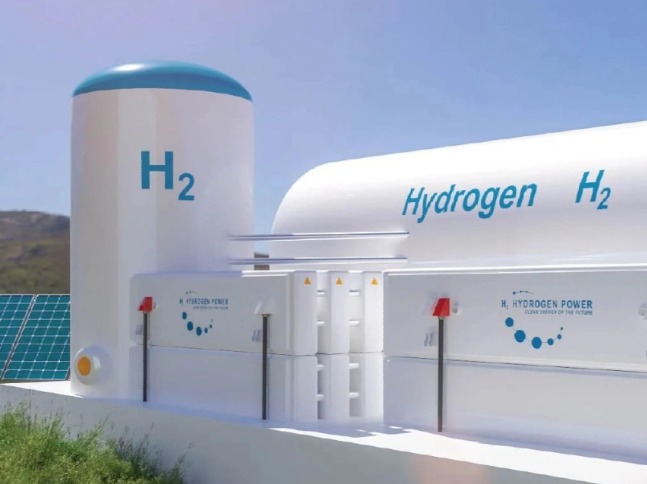
- India has launched its first-ever port-based green hydrogen pilot project at V.O. Chidambaranar (VOC) Port, Tuticorin, Tamil Nadu. With a production capacity of 10 Nm³ per hour and built at a cost of ₹3.87 crore, the facility powers streetlights and an EV charging station within the port colony.
- This milestone makes VOC Port the first Indian port to generate green hydrogen onsite, supporting the Coastal Green Shipping Corridor between Kandla and Tuticorin under the Sagarmala programme.
- In parallel, foundation work began for a Green Methanol Bunkering and Refuelling Facility with a 750 m³ capacity and ₹35.34 crore investment. This will position VOC Port as a green bunkering hub in South India, encouraging cleaner fuels in the shipping sector.
- The port has also expanded its renewable capacity with a 400 KW rooftop solar plant, raising its total to 1.04 MW—the highest among Indian ports.
- Additional projects include a 6 MW wind farm, a ₹90 crore multi-cargo berth, a ₹24.5 crore link conveyor to improve coal handling by 0.72 MMTPA, a 3.37 km four-lane road, and a maritime heritage museum.
- Strategically located on the Coromandel Coast, VOC Port is one of India’s 13 major ports and a key centre for trade, coal handling, and container movement. Over ₹16,000 crore has been invested in its modernisation under the Sagarmala programme.
- The port’s green initiatives align with Viksit Bharat 2047 goals, aiming to strengthen sustainability, self-reliance, and India’s ambition to emerge as a top shipbuilding nation by 2030 and beyond.
- Collaborations include MoUs with the Indian Port Rail and Ropeway Corporation Ltd for rail connectivity to the Outer Harbour project and with NTPC for green mobility initiatives.
- These partnerships are expected to boost employment, attract global investments, and accelerate Tamil Nadu’s role in India’s clean energy transition.
Limited-time offerGet up to 75% OFFGrab the offer
India Launches First Port-Based Green Hydrogen Project at VOC Port, Tamil Nadu
Pilot initiative powers port operations and marks VOC Port as a hub for green energy and sustainable shipping
Check your eligibility now