
HQ-16 Missile Replica and U.S. Military Training Strategy:
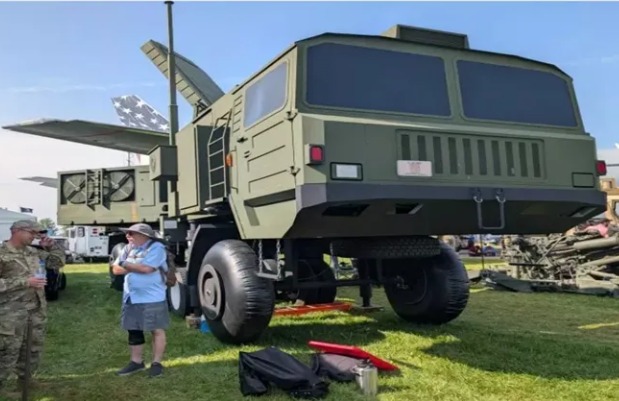
- In a significant development at the Experimental Aircraft Association (EAA) AirVenture Show in Oshkosh, Wisconsin, from July 21-27, 2025, the U.S. Air Force and Wisconsin National Guard unveiled a full-scale replica of China’s HQ-16 surface-to-air missile (SAM) system, known by its NATO designation CH-SA-16.
- This mockup, displayed as a towable surrogate target, underscores the U.S. military’s focus on preparing pilots for potential conflicts with advanced Chinese air defense systems, reflecting evolving geopolitical tensions.
HQ-16 Replica at EAA AirVenture 2025:
- Event: On July 25, 2025, the Wisconsin National Guard’s Volk Field Combat Readiness Training Center showcased an HQ-16 towable surrogate target at Wittman Regional Airport during the EAA AirVenture Show, the world’s largest aviation gathering.
- Purpose: The replica, designed to mimic the HQ-16’s radar vehicle and operational characteristics, serves as a training aid to familiarize fifth-generation fighter pilots (e.g., F-35, F-22) with modern SAM systems they may encounter in combat scenarios, particularly against China’s air defense architecture.
- Significance: The unveiling marks a shift in U.S. training, moving from Soviet/Russian-based threat mockups (e.g., SA-2, SA-6, SA-20) to Chinese systems, reflecting the Pentagon’s increasing focus on the People’s Liberation Army (PLA) as a peer adversary.
- Features of the Replica: The surrogate replicates the HQ-16’s transporter erector launcher (TEL) and radar unit, incorporating radar reflectivity, thermal emissions via heaters, and reflective panels to simulate real-world signatures for pilot training.
- Context: The display coincides with U.S. participation in Pacific war games like Talisman Sabre 2025, highlighting growing concerns about Chinese military capabilities in the Indo-Pacific.
About the HQ-16 Missile:
- Overview: The HQ-16 (Hong Qi-16, or Red Banner-16) is a Chinese medium-range SAM system developed by the Shanghai Academy of Spaceflight Technology (SAST) under China Aerospace Science and Technology Corporation (CASC), with reported assistance from Russia’s Almaz-Antey. It is derived from the Russian Buk-M1 and Buk-M2 systems.
- Purpose: Designed to engage aircraft, cruise missiles, helicopters, and unmanned aerial vehicles (UAVs) at medium altitudes, filling the gap between China’s short-range HQ-7 (15 km) and long-range HQ-9 (200 km) systems.
- Operational History: Entered service in 2011 (HQ-16A) and is deployed by the PLA on land and naval platforms (HHQ-16 on Type 054A frigates). Exported as LY-80 to Pakistan in 2017.
HQ-16 Missile Features:
- Design: Mounted on a 6×6 high-mobility truck chassis for enhanced road mobility and maintenance compared to tracked Buk systems. Features a vertical launch system (VLS) for 360-degree coverage, enabling operations in complex terrains.
- Missile Specifications:
- Weight: 650 kg
- Length: 5.2 m
- Diameter: 0.34 m
- Speed: Mach 3
- Range: 40 km (HQ-16A) for aircraft; 3.5–12 km for cruise missiles at 300 m/s; upgraded HQ-16B/C/FE variants extend to 70–160 km.
- Altitude: 15–18 km for aerial targets; as low as 10 m for sea-skimming missiles (naval variant).
- Guidance: Combines inertial guidance, mid-course wireless commands, and semi-active radar homing in the terminal phase, offering strong anti-jamming capabilities.
- Battery Composition: Includes a command post, two multifunction radars (L-band and S-band, detecting up to 144 targets and tracking 48), and 4–6 launchers, each with 6 missiles. Single-shot kill probability: 85% (aircraft), 60% (cruise missiles).
- Variants: HQ-16A (land-based, 40 km), HQ-16B/C (70 km), HQ-16FE (160 km, showcased at Zhuhai Airshow 2022), and naval HHQ-16 for Type 054A/B frigates.
Strategic Implications:
- U.S. Training Shift: The HQ-16 replica reflects the U.S. military’s pivot to countering Chinese air defense systems, critical for operations in contested regions like the South China Sea or Taiwan Strait. It enhances pilot training for suppressing enemy air defenses (SEAD) using stealth aircraft and electronic warfare.
- Geopolitical Context: China’s deployment of HQ-16 systems strengthens its layered air defense, challenging U.S. and allied air superiority. The U.S. replica counters this by preparing pilots for realistic threat scenarios, signaling heightened preparedness for potential Indo-Pacific conflicts.
- China’s Response: Chinese experts, like Wang Ya’nan of Aerospace Knowledge, downplayed the replica as a “simulation training device” for visual and sensor training, suggesting it lacks full fidelity and serves more as U.S. propaganda.
- Global Proliferation: Pakistan’s use of the LY-80 variant underscores the HQ-16’s export success, increasing its relevance as a training target for U.S. and allied forces operating in South Asia.
Challenges and Criticisms:
- Fidelity of Replica: Chinese observers argue the replica’s inauthentic features (e.g., tires) limit its realism, though its radar and thermal simulation capabilities enhance training effectiveness.
- Environmental Concerns: Training with surrogates requires large test ranges, potentially impacting local ecosystems, though specific impacts at Volk Field are not detailed.
- Escalation Risks: Publicly showcasing the HQ-16 replica may heighten U.S.-China tensions, as it signals explicit preparation for conflict, potentially prompting China to accelerate its own defense advancements.
- Defense and Security: The HQ-16 replica highlights the U.S.’s strategic focus on countering China’s military modernization, a key aspect of global power dynamics.
- Geopolitics: Reflects U.S.-China rivalry in the Indo-Pacific, with implications for India’s defense strategy, given China’s HQ-16 deployments and Pakistan’s LY-80 systems.
- Technology and Innovation: The HQ-16’s advanced radar and vertical launch capabilities underscore the importance of missile defense technology in modern warfare.
- International Relations: The U.S.’s public display of the replica amid Pacific war games signals a shift toward overt deterrence, relevant to India’s balancing act in U.S.-China relations.
Conclusion:
- The unveiling of the HQ-16 replica at EAA AirVenture 2025 underscores the U.S. military’s proactive approach to countering China’s advanced air defense systems through realistic pilot training.
- The HQ-16, with its versatile design and growing global presence, poses a significant challenge to air superiority, making it a critical focus for U.S. and allied forces.