
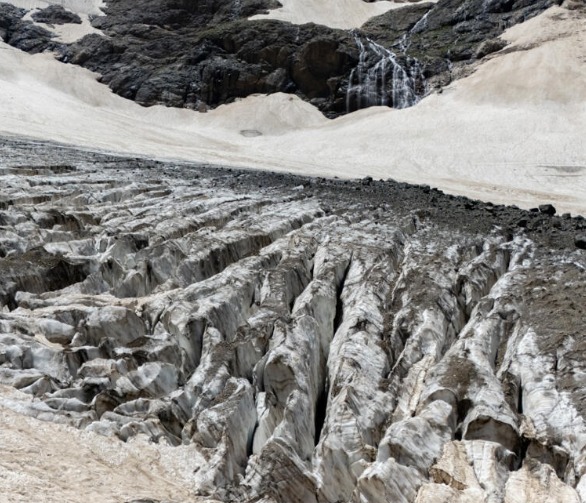
Mount Cilo: Latest Findings and Climate Impact
Glacier Loss and Climate Change:
- Recent research shows that Mount Cilo’s glaciers have lost nearly 50 percent of their ice cover over the past 40 years.
- This dramatic shrinkage highlights the accelerating effects of climate change in Turkey, especially in high-altitude regions.
- Turkey has been experiencing rising temperatures, prolonged droughts, and recently recorded a historic temperature of 50.5 degrees Celsius, contributing to the melting of glaciers nationwide.
Location:
- Mount Cilo is located in southeastern Turkey, in the province of Hakkari.
- It lies southeast of Lake Van and marks the easternmost extension of the Taurus Mountain range in the Anatolian region.
- Geographically, it stands close to the Turkish-Iraqi border.
- Altitude and Rank
- With an elevation of 4,135 meters, Mount Cilo hosts the second-largest glacier system in Turkey, after Mount Ararat, which rises to 5,137 meters.
Geological Background:
- Mount Cilo is part of the Alpine-Himalayan Fold System.
- It was formed by the tectonic interactions among the Arabian, Anatolian, and Eurasian plates.
- The mountain's present shape is the result of long-term tectonic activity and erosion processes.
Physical Features:
- Mount Cilo features a rugged and dramatic topography.
- It consists of sharp ridges, steep limestone cliffs, deep gorges, and glacial valleys.
There are five prominent high peaks in the region:
- Uludoruk Peak
- Suppa Durek Peak
- Kosedireği Mountain
- Kisara Mountain
- Maunseli Sivrisi
- These physical features make the mountain not only a geographical marvel but also a vital water source and a sensitive ecological zone.
Environmental Significance and Threats:
- The glaciers of Mount Cilo are a key source of freshwater for the surrounding regions.
- Their rapid loss could affect local ecosystems, reduce water availability, and increase the risk of natural hazards like landslides and flash floods.
- This glacial retreat also reflects broader climate patterns impacting the Middle East and Anatolian plateau.
Conclusion:
- Mount Cilo stands as both a geological treasure and a climate indicator.
- The near 50 percent loss of its glacier mass over four decades is a serious warning about the long-term impacts of global warming.
- Preservation efforts and climate adaptation strategies are now more critical than ever for Turkey’s high mountain ecosystems.