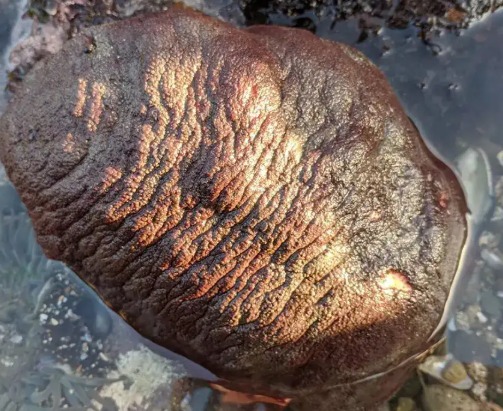
- A recent groundbreaking study has found that chitons — flattened, bilaterally symmetrical marine mollusks — possess teeth harder than stainless steel, zirconium oxide, and even human enamel.
- Chitons belong to the phylum Mollusca (alongside sea snails, sea slugs, and bivalves) and are found exclusively in marine habitats, with around 600 known species, most abundant in warm seas.
- Typically oval in shape and varying in colors from grey and brown to red, green, and pink, chitons have a dorsal surface covered by eight overlapping plates surrounded by a tough girdle.
- They move and cling to rocks using a large flat foot and feed using a radula — a filelike structure — to scrape algae from surfaces.
- Chitons can reach up to 5 cm in length, are highly flexible, and can fit into rock crevices or curl into a ball for protection. Their remarkable adhesion to rocks makes them difficult to remove without causing injury.
- With lifespans ranging from a few years to 20 years and mostly nocturnal habits, chitons demonstrate impressive adaptations — including their newly discovered ultra-hard teeth — for survival in their rocky marine environments.
Limited-time offerGet up to 75% OFFGrab the offer
Chiton Teeth Found to Be Harder Than Stainless Steel, Study Reveals
Marine mollusks’ super-hard teeth surpass zirconium oxide and human enamel in strength
Check your eligibility now