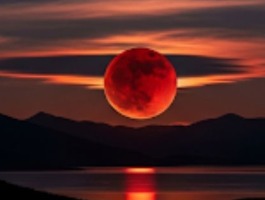
- Millions of skywatchers across Asia and Europe are preparing to witness a celestial spectacle as a total lunar eclipse will transform the Moon into a glowing red disc, popularly known as the “Blood Moon.”
- The event occurs when the Earth passes directly between the Sun and the Moon, casting its shadow on the lunar surface and blocking direct sunlight.
- Unlike a solar eclipse, which can be viewed only from limited regions, this phenomenon will be visible to large populations across continents.
- A Blood Moon derives its distinctive colour from a process known as Rayleigh scattering. As the Earth’s atmosphere bends and filters sunlight during the eclipse, shorter wavelengths such as blue are scattered out, while the longer red wavelengths pass through and reach the Moon’s surface.
- As a result, instead of turning completely dark, the Moon glows in shades of red, orange, or copper depending on atmospheric conditions, pollution levels, and even volcanic activity at the time.
- During the phase of totality, the Moon is entirely within the umbra, the darkest part of the Earth’s shadow. This is when the transformation is most striking, giving rise to the dramatic crimson glow that has fascinated humans for centuries and led to the term “Blood Moon.”
- The actual hue of the Moon can vary from deep red to a soft orange, influenced by how much dust or cloud cover is present in the Earth’s atmosphere.
- The underlying physics of the phenomenon was explained by Nobel laureate John William Strutt, known as Lord Rayleigh, in the 19th century.
- He demonstrated that when light interacts with particles smaller than its wavelength, the intensity of scattering is inversely proportional to the wavelength.
- This principle, called Rayleigh scattering, not only explains the reddish Moon during a lunar eclipse but also the blue colour of the Earth’s daytime sky, which corresponds to the shortest visible wavelength.
- Beyond its scientific explanation, the Blood Moon remains one of the most spectacular sights in the night sky, blending science and wonder.
- For astronomers, it offers an opportunity to study atmospheric conditions on Earth, while for the general public, it provides a rare natural show that needs no telescopes or protective glasses-just a clear sky and an open horizon.
Limited-time offerGet up to 75% OFFGrab the offer
Blood Moon to Dazzle Skies as Asia and Europe Witness Total Lunar Eclipse
Rayleigh scattering turns the Moon red during Earth’s shadow play, creating one of nature’s most dramatic spectacles
Check your eligibility now