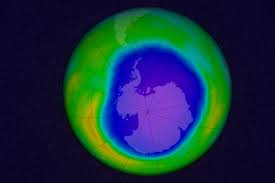
- The Antarctic ozone hole of 2025 has shown significant improvement, now ranking as the fifth smallest since 1992 and collapsing weeks earlier than the long-term average. Scientists from NASA and NOAA credit this progress to the Montreal Protocol, which has successfully reduced ozone-depleting chemicals in the atmosphere over the past several decades.
- 2025 का अंटार्कटिका ओज़ोन छिद्र उल्लेखनीय सुधार दर्शा रहा है और 1992 के बाद से पाँचवें सबसे छोटे स्तर के रूप में दर्ज किया गया है। यह औसत समय से कई सप्ताह पहले समाप्त भी हो गया, जिससे यह सकारात्मक प्रगति और स्पष्ट हुई। NASA और NOAA के वैज्ञानिक इस सुधार का श्रेय मॉन्ट्रियल प्रोटोकॉल को देते हैं, जिसने वातावरण में ओज़ोन-नाशक रसायनों को काफी हद तक कम किया है।
- Between early September and mid-October, the ozone hole measured an average size of 18.71 million square kilometres — far smaller than typical levels observed in previous decades. Its largest single-day span was recorded on 9 September at 22.86 million square kilometres, about 30% less than the record-breaking peak seen in 2006. Satellite observations since 1979 place the 2025 ozone hole among the smallest in more than 40 years.
- सितंबर की शुरुआत से अक्टूबर के मध्य तक ओज़ोन छिद्र का औसत आकार 18.71 मिलियन वर्ग किलोमीटर रहा, जो पिछले दशकों की तुलना में काफी छोटा है। 9 सितंबर को इसका सबसे बड़ा एक-दिवसीय विस्तार 22.86 मिलियन वर्ग किलोमीटर दर्ज किया गया, जो 2006 के रिकॉर्ड स्तर से लगभग 30% कम था। 1979 से उपग्रह अवलोकनों के आधार पर 2025 का ओज़ोन छिद्र पिछले 40 वर्षों में सबसे छोटे दर्ज मामलों में शामिल है।
- Researchers note that ozone-depleting substances have reduced by nearly one-third globally since their peak around the year 2000. This turnaround is attributed to the international ban on chemicals such as CFCs under the Montreal Protocol — a step experts say has prevented the ozone hole from becoming significantly larger.
- शोधकर्ताओं के अनुसार, वर्ष 2000 के आसपास चरम पर पहुंचने के बाद से दुनिया भर में ओज़ोन-नाशक पदार्थों में लगभग एक-तिहाई की कमी दर्ज की गई है। यह परिवर्तन मॉन्ट्रियल प्रोटोकॉल के तहत CFC जैसे रसायनों पर अंतरराष्ट्रीय प्रतिबंध का परिणाम है — वैज्ञानिकों का कहना है कि यदि यह हस्तक्षेप न होता तो इस वर्ष ओज़ोन छिद्र बहुत अधिक बड़ा होता।
- Meteorologists add that favourable atmospheric conditions played a role this year. A weaker polar vortex in August kept stratospheric temperatures relatively high, reducing ozone destruction and causing the hole to shrink earlier than usual. Balloon soundings recorded a minimum of 147 Dobson Units over the South Pole in early October — much higher than the historic low of 92 Dobson Units recorded in 2006.
- मौसम वैज्ञानिकों का कहना है कि इस वर्ष अनुकूल वायुमंडलीय परिस्थितियों का भी सकारात्मक प्रभाव पड़ा। अगस्त में कमजोर पोलर वर्टेक्स के कारण समताप मंडल का तापमान सामान्य से अधिक बना रहा, जिससे ओज़ोन के क्षरण में कमी आई और छिद्र अपेक्षा से पहले घटकर समाप्त हो गया। अक्टूबर की शुरुआत में साउथ पोल के ऊपर गुब्बारा सर्वेक्षणों में न्यूनतम 147 डॉबसन यूनिट दर्ज किए गए — जो 2006 के ऐतिहासिक न्यूनतम 92 डॉबसन यूनिट से कहीं अधिक हैं।
Limited-time offerGet up to 75% OFFGrab the offer
Antarctic Ozone Hole Shrinks to One of the Smallest in Decades
The Antarctic ozone hole of 2025 has shown significant improvement, now ranking as the fifth smallest since 1992 and collapsing weeks earlier than the long-term
Check your eligibility now