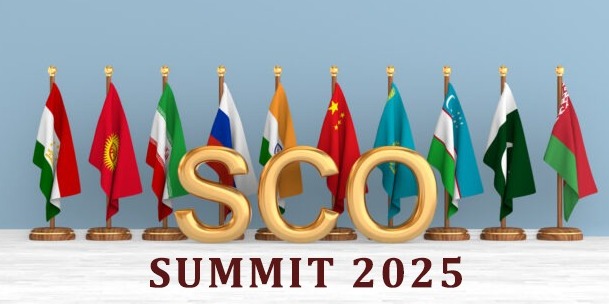
- Prime Minister Narendra Modi attended the 25th Summit of the Shanghai Cooperation Organization (SCO) in Tianjin, China, where leaders held wide-ranging discussions on global governance reform, counter-terrorism, peace and security, economic cooperation, and sustainable development.
- The summit highlighted SCO’s growing role as a multilateral platform shaping regional and international affairs.
- The SCO, established in 2001 by China, Russia, Kazakhstan, Kyrgyzstan, Tajikistan and Uzbekistan, now has 10 member states, two observer states, and 15 dialogue partners from Asia, Europe, and Africa.
- During the 2025 summit, Laos was granted partner status. Earlier, in 2017 at Astana, India and Pakistan officially became full members of the grouping.
- The Tianjin summit marked an important milestone with the signing of 20 significant documents that set the agenda for SCO’s future.
- The Tianjin Declaration was adopted as the central political outcome of the summit. A Development Strategy for 2026–2035 was approved, providing long-term priorities and direction for the next decade.
- Member states also adopted a Cooperation Programme (2026–2030) to counter extremist ideology, and a Roadmap for Energy Cooperation until 2030. Additionally, SCO was granted observer status within the Commonwealth of Independent States (CIS).
- In a cultural highlight, Cholpon Ata in the Kyrgyz Republic was declared the SCO tourist and cultural capital for 2025–2026.
- Institutional strengthening was a major focus of the summit. Four new SCO centers were inaugurated with mandates for countering security threats, tackling transnational organized crime, enhancing information and cybersecurity, and strengthening anti-drug cooperation.
- In another significant development, a decision was taken to establish an SCO Development Bank to support infrastructure development, economic growth, and social cooperation among member states.
- The 25th SCO Summit reaffirmed the organization’s commitment to regional stability, inclusive growth, and multilateral engagement, positioning it as a critical player in shaping the geopolitical and economic future of the Eurasian region.
Limited-time offerGet up to 75% OFFGrab the offer
25th SCO Summit 2025 Held in Tianjin, China
PM Modi Participates as Member States Adopt Key Declarations and Strengthen Institutional Frameworks
Check your eligibility now