Why In News?
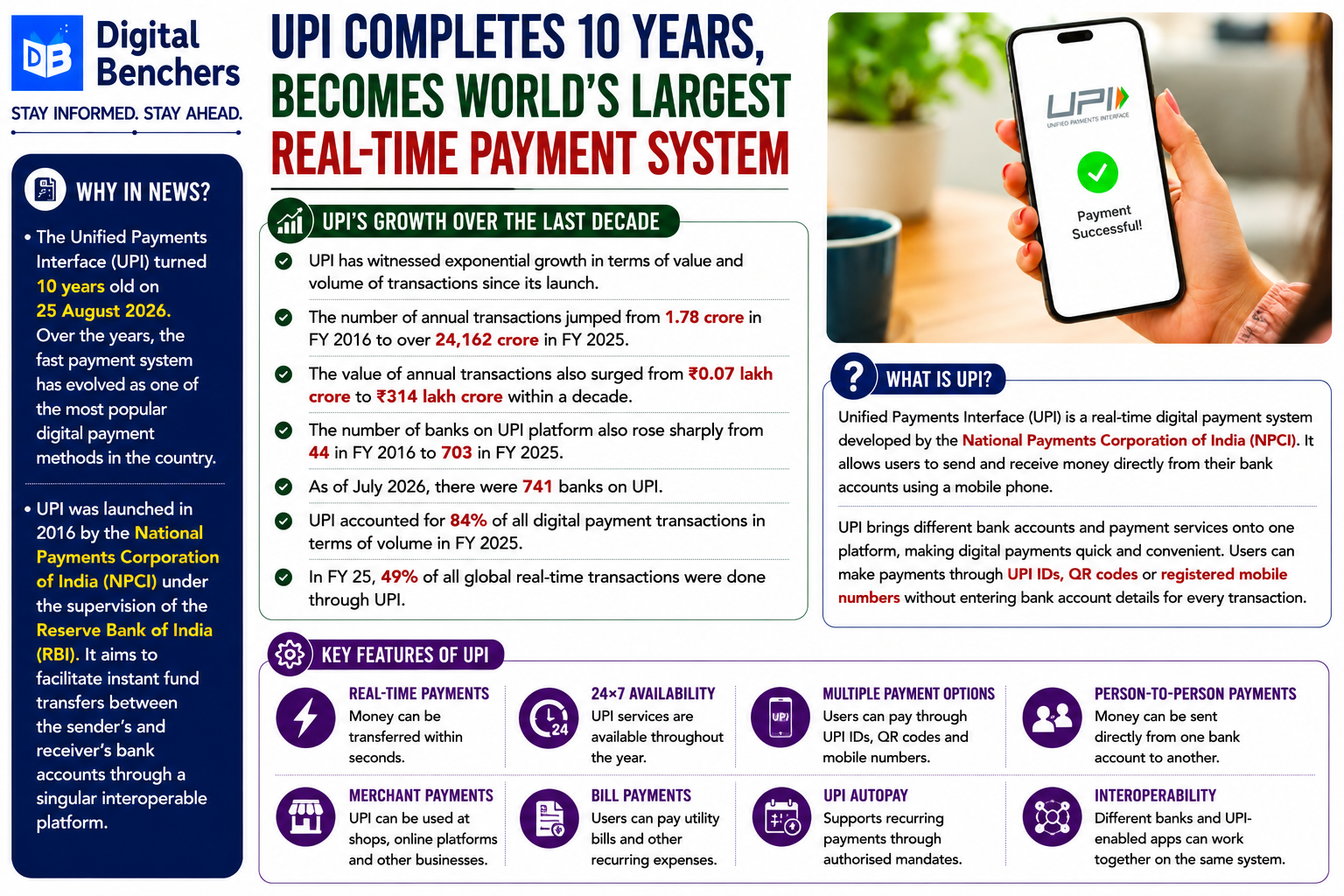
- The Unified Payments Interface (UPI) turned 10 years old on 25 August 2026. Over the years, the fast payment system has evolved as one of the most popular digital payment methods in the country.
- UPI was launched in 2016 by the National Payments Corporation of India (NPCI) under the supervision of the Reserve Bank of India (RBI). It aims to facilitate instant fund transfers between the sender’s and receiver’s bank accounts through a singular interoperable platform.
UPI’s Growth Over the Last Decade
- UPI has witnessed exponential growth in terms of value and volume of transactions since its launch.
- The number of annual transactions jumped from 1.78 crore in FY 2016 to over 24,162 crore in FY 2025.
- The value of annual transactions also surged from ₹0.07 lakh crore to ₹314 lakh crore within a decade.
- The number of banks on UPI platform also rose sharply from 44 in FY 2016 to 703 in FY 2025.
- As of July 2026, there were 741 banks on UPI. UPI accounted for 84% of all digital payment transactions in terms of volume in FY 2025. And in FY 25, 49% of all global real-time transactions were done through UPI.
What is UPI?
- Unified Payments Interface (UPI) is a real-time digital payment system developed by the National Payments Corporation of India (NPCI). It allows users to send and receive money directly from their bank accounts using a mobile phone.
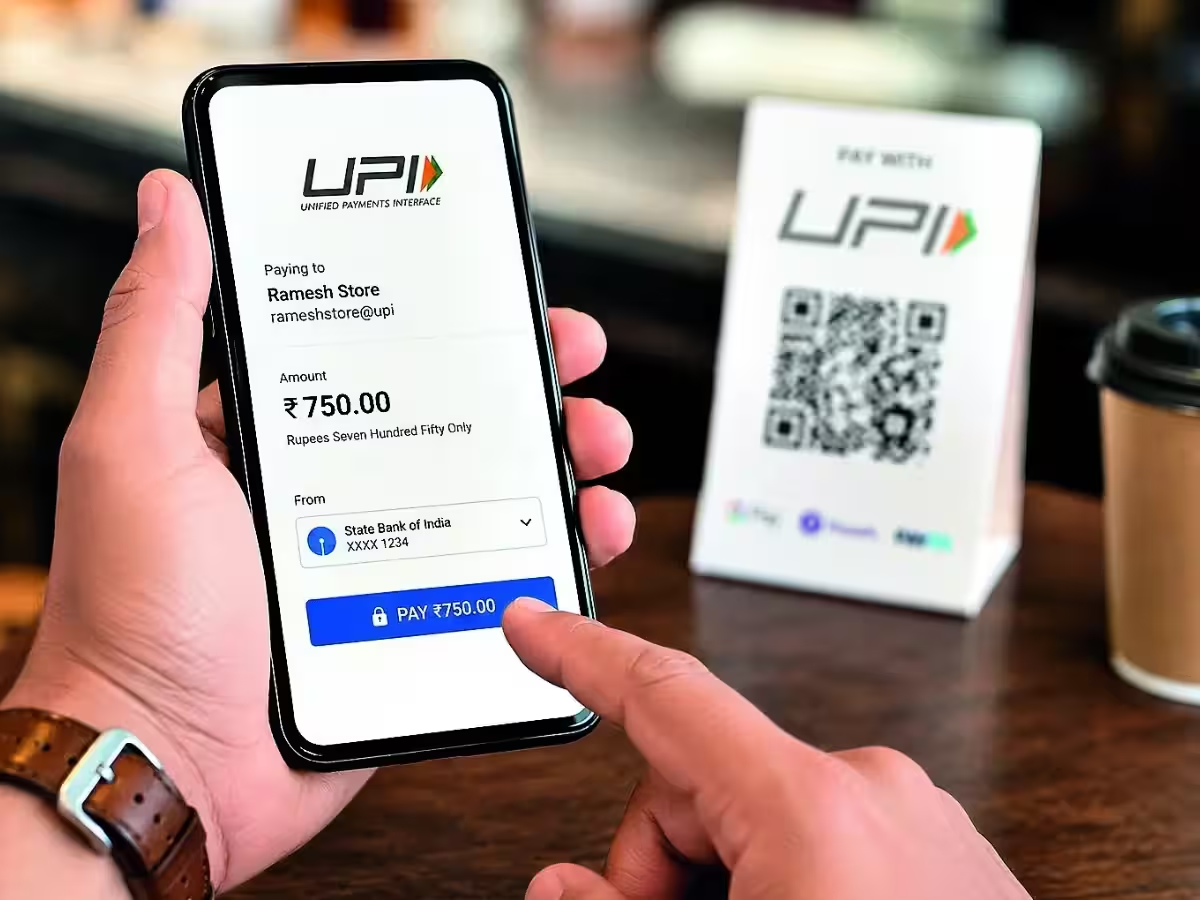
- UPI brings different bank accounts and payment services onto one platform, making digital payments quick and convenient. Users can make payments through UPI IDs, QR codes or registered mobile numbers without entering bank account details for every transaction.
Key Features of UPI
- Real-time payments: Money can be transferred within seconds.
- 24×7 availability: UPI services are available throughout the year.
- Multiple payment options: Users can pay through UPI IDs, QR codes and mobile numbers.
- Person-to-person payments: Money can be sent directly from one bank account to another.
- Merchant payments: UPI can be used at shops, online platforms and other businesses.
- Bill payments: Users can pay utility bills and other recurring expenses.
- UPI AutoPay: Supports recurring payments through authorised mandates.
- Interoperability: Different banks and UPI-enabled apps can work together on the same system.