Why in News?
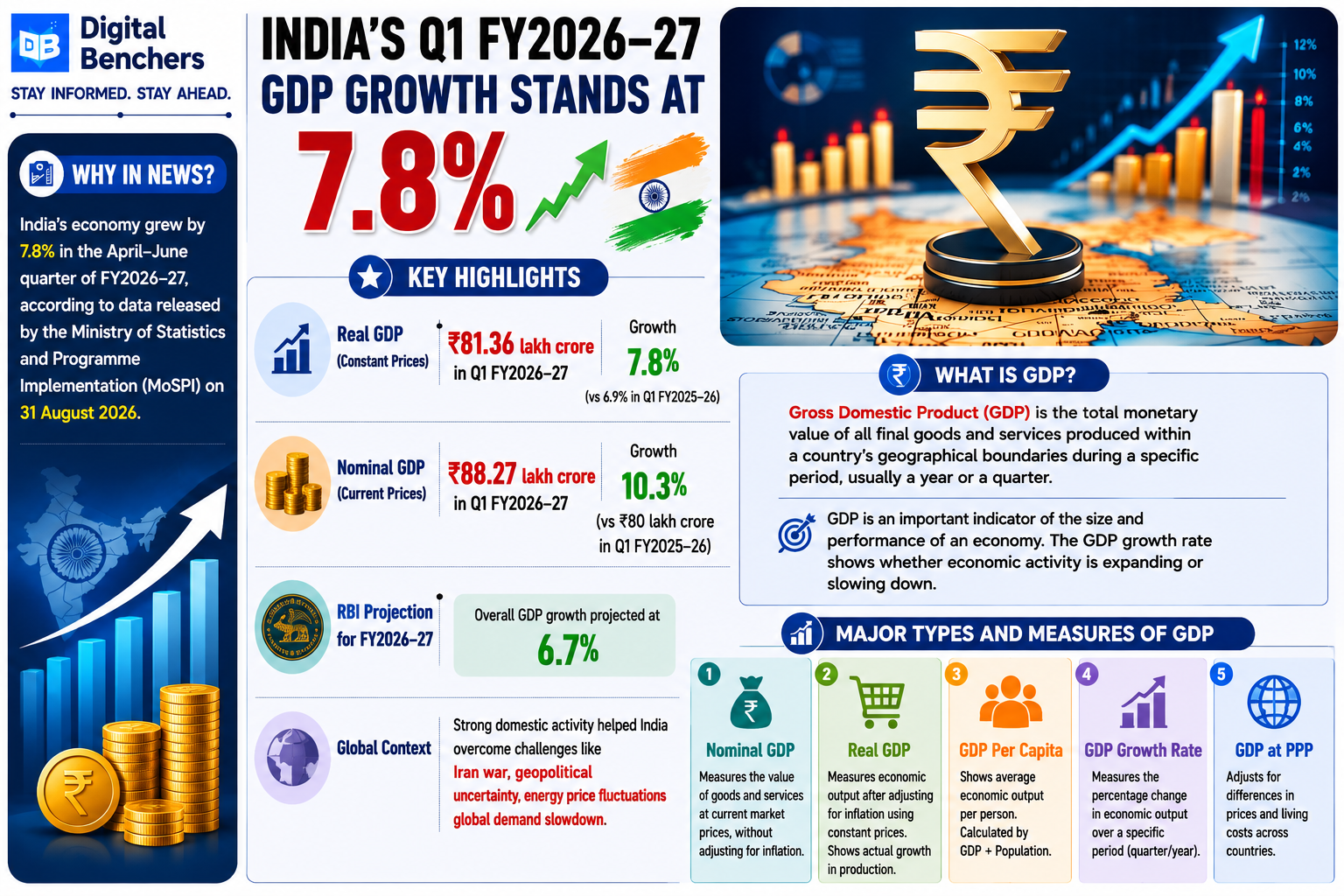
India’s economy grew by 7.8% in the April–June quarter of FY2026–27, according to data released by the Ministry of Statistics and Programme Implementation (MoSPI) on 31 August 2026. The growth was stronger than expected and surpassed the Reserve Bank of India’s (RBI) earlier estimate of 7% for the quarter.
Key Highlights
- India’s real GDP, measured at constant prices, was estimated at ₹81.36 lakh crore in Q1 FY2026–27, compared with ₹75.46 lakh crore during the same quarter of the previous financial year. This represents a year-on-year growth of 7.8%, up from 6.9% in Q1 FY2025–26.
- Nominal GDP, which is measured at current prices, stood at ₹88.27 lakh crore, compared with ₹80 lakh crore in the corresponding quarter of the previous year. It recorded a growth of 10.3%.
- The strong Q1 performance came despite concerns that the Iran war, geopolitical uncertainty, fluctuations in energy prices and global demand could adversely affect economic growth. Strong domestic economic activity helped India absorb some of these external pressures.
- The RBI has projected India’s overall GDP growth at 6.7% for FY2026–27.
What is GDP?
- Gross Domestic Product (GDP) is the total monetary value of all final goods and services produced within a country’s geographical boundaries during a specific period, usually a year or a quarter.
- GDP is an important indicator of the size and performance of an economy. The GDP growth rate shows whether economic activity is expanding or slowing down.
Major Types and Measures of GDP
- Nominal GDP: Nominal GDP measures the value of goods and services at current market prices, without adjusting for inflation.
- Real GDP: Real GDP measures economic output after adjusting for inflation. It uses constant prices and therefore gives a better picture of the economy’s actual growth in production.
- GDP Per Capita: GDP per capita shows the average economic output per person. It is calculated by dividing total GDP by the population.
- GDP Growth Rate: The GDP growth rate measures the percentage change in economic output over a specific period, such as a quarter or a year.
- GDP at Purchasing Power Parity (PPP): GDP at PPP adjusts for differences in prices and living costs across countries.