Why in News?
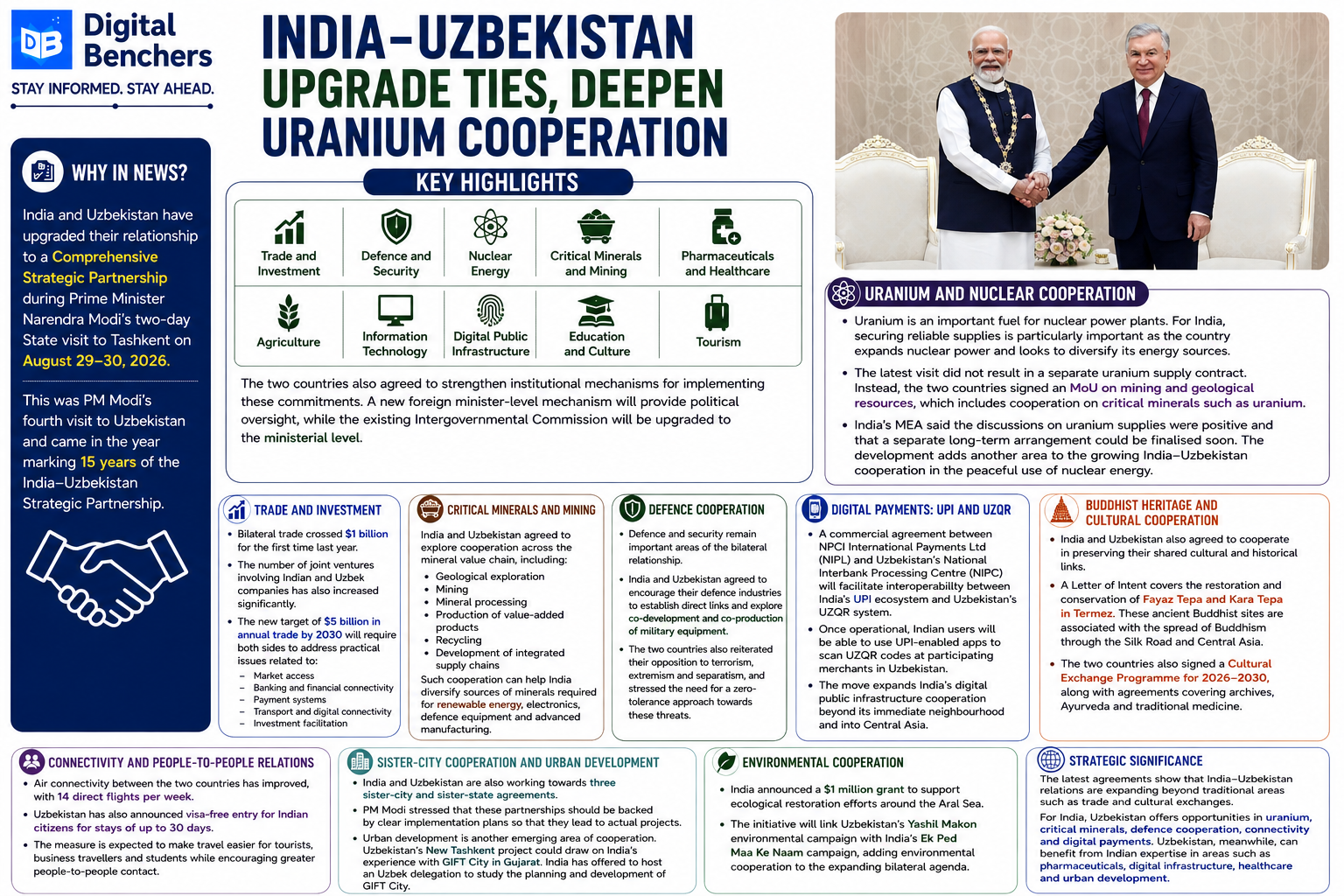
India and Uzbekistan have upgraded their relationship to a Comprehensive Strategic Partnership during Prime Minister Narendra Modi’s two-day State visit to Tashkent on August 29–30, 2026. This was PM Modi’s fourth visit to Uzbekistan and came in the year marking 15 years of the India–Uzbekistan Strategic Partnership.
Key Highlights
Uranium and Nuclear Cooperation
- Uranium is an important fuel for nuclear power plants. For India, securing reliable supplies is particularly important as the country expands nuclear power and looks to diversify its energy sources.
- The latest visit did not result in a separate uranium supply contract. Instead, the two countries signed an MoU on mining and geological resources, which includes cooperation on critical minerals such as uranium.
- India’s MEA said the discussions on uranium supplies were positive and that a separate long-term arrangement could be finalised soon. The development adds another area to the growing India–Uzbekistan cooperation in the peaceful use of nuclear energy.
Comprehensive Strategic Partnership
The new status gives India–Uzbekistan relations a wider framework for cooperation. Key areas include:
- Trade and investment
- Defence and security
- Nuclear energy
- Critical minerals and mining
- Pharmaceuticals and healthcare
- Agriculture
- Information technology
- Digital public infrastructure
- Education and culture
- Tourism
The two countries also agreed to strengthen institutional mechanisms for implementing these commitments. A new foreign minister-level mechanism will provide political oversight, while the existing Intergovernmental Commission will be upgraded to the ministerial level.
Trade and Investment
Bilateral trade crossed $1 billion for the first time last year. The number of joint ventures involving Indian and Uzbek companies has also increased significantly.
The new target of $5 billion in annual trade by 2030 will require both sides to address practical issues related to:
- Market access
- Banking and financial connectivity
- Payment systems
- Transport and digital connectivity
- Investment facilitation
Critical Minerals and Mining
Critical minerals have become an important part of India's economic and strategic priorities. India and Uzbekistan agreed to explore cooperation across the mineral value chain, including:
- Geological exploration
- Mining
- Mineral processing
- Production of value-added products
- Recycling
- Development of integrated supply chains
Such cooperation can help India diversify sources of minerals required for renewable energy, electronics, defence equipment and advanced manufacturing.
Defence Cooperation
- Defence and security remain important areas of the bilateral relationship.
- India and Uzbekistan agreed to encourage their defence industries to establish direct links and explore co-development and co-production of military equipment.
- The two countries also reiterated their opposition to terrorism, extremism and separatism, and stressed the need for a zero-tolerance approach towards these threats.
Digital Payments: UPI and UZQR
- A commercial agreement between NPCI International Payments Ltd (NIPL) and Uzbekistan’s National Interbank Processing Centre (NIPC) will facilitate interoperability between India’s UPI ecosystem and Uzbekistan’s UZQR system.
- Once operational, Indian users will be able to use UPI-enabled apps to scan UZQR codes at participating merchants in Uzbekistan.
- The move expands India's digital public infrastructure cooperation beyond its immediate neighbourhood and into Central Asia.
Buddhist Heritage and Cultural Cooperation
- India and Uzbekistan also agreed to cooperate in preserving their shared cultural and historical links.
- A Letter of Intent covers the restoration and conservation of Fayaz Tepa and Kara Tepa in Termez. These ancient Buddhist sites are associated with the spread of Buddhism through the Silk Road and Central Asia.
- The two countries also signed a Cultural Exchange Programme for 2026–2030, along with agreements covering archives, Ayurveda and traditional medicine.
Connectivity and People-to-People Relations
- Air connectivity between the two countries has improved, with 14 direct flights per week.
- Uzbekistan has also announced visa-free entry for Indian citizens for stays of up to 30 days. The measure is expected to make travel easier for tourists, business travellers and students while encouraging greater people-to-people contact.
Sister-City Cooperation and Urban Development
- India and Uzbekistan are also working towards three sister-city and sister-state agreements.
- PM Modi stressed that these partnerships should be backed by clear implementation plans so that they lead to actual projects.
- Urban development is another emerging area of cooperation. Uzbekistan’s New Tashkent project could draw on India’s experience with GIFT City in Gujarat. India has offered to host an Uzbek delegation to study the planning and development of GIFT City.
Environmental Cooperation
- India announced a $1 million grant to support ecological restoration efforts around the Aral Sea.
- The initiative will link Uzbekistan’s Yashil Makon environmental campaign with India’s Ek Ped Maa Ke Naam campaign, adding environmental cooperation to the expanding bilateral agenda.
Strategic Significance
- The latest agreements show that India–Uzbekistan relations are expanding beyond traditional areas such as trade and cultural exchanges.
- For India, Uzbekistan offers opportunities in uranium, critical minerals, defence cooperation, connectivity and digital payments. Uzbekistan, meanwhile, can benefit from Indian expertise in areas such as pharmaceuticals, digital infrastructure, healthcare and urban development.