
Why in News?
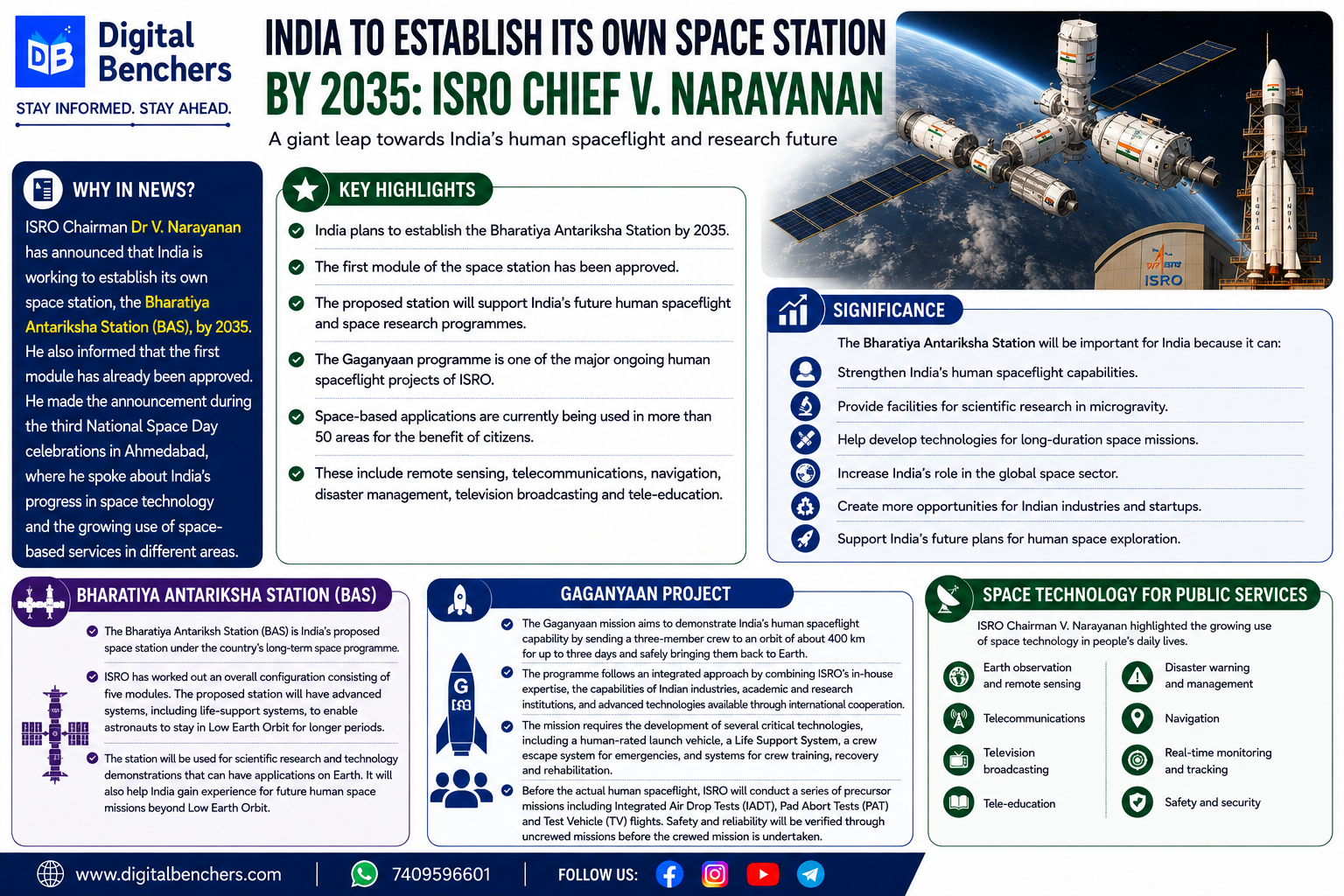
ISRO Chairman Dr V. Narayanan has said that India is working to establish its own space station, the Bharatiya Antariksha Station (BAS), by 2035. He also informed that the first module of the proposed space station has already been approved. He made the announcement during the third National Space Day celebrations in Ahmedabad, where he spoke about India's progress in space technology and the growing use of space-based services in different areas.
Key Highlights
- India plans to establish the Bharatiya Antariksha Station by 2035.
- The first module of the space station has been approved.
- The proposed station will support India's future human spaceflight and space research programmes.
- The Gaganyaan programme is one of the major ongoing human spaceflight projects of ISRO.
- Space-based applications are currently being used in more than 50 areas for the benefit of citizens.
- These include remote sensing, telecommunications, navigation, disaster management, television broadcasting and tele-education.
Bharatiya Antariksha Station
- The Bharatiya Antariksh Station (BAS) is India's proposed space station under the country's long-term space programme.
- ISRO has worked out an overall configuration consisting of five modules. The proposed station will have advanced systems, including life-support systems, to enable astronauts to stay in Low Earth Orbit for longer periods.
- The station will be used for scientific research and technology demonstrations that can have applications on Earth. It will also help India gain experience for future human space missions beyond Low Earth Orbit.
Gaganyaan Project
- The Gaganyaan mission aims to demonstrate India's human spaceflight capability by sending a three-member crew to an orbit of about 400 km for up to three days and safely bringing them back to Earth, with the crew expected to land in Indian sea waters.
- The programme follows an integrated approach by combining ISRO's in-house expertise, the capabilities of Indian industries, academic and research institutions, and advanced technologies available through international cooperation.
- The mission requires the development of several critical technologies, including a human-rated launch vehicle, a Life Support System to maintain a suitable environment for astronauts, a crew escape system for emergencies, and comprehensive systems for crew training, recovery and rehabilitation.
- Before the actual human spaceflight, ISRO will conduct a series of precursor missions to demonstrate the required level of technological readiness. These include Integrated Air Drop Tests (IADT), Pad Abort Tests (PAT) and Test Vehicle (TV) flights. The safety and reliability of the systems will be verified through uncrewed missions before the crewed mission is undertaken.
Space Technology for Public Services
ISRO Chairman V. Narayanan highlighted the growing use of space technology in people's daily lives. Space-based applications are being used for:
- Earth observation and remote sensing
- Telecommunications
- Television broadcasting
- Tele-education
- Disaster warning and management
- Navigation
- Real-time monitoring and tracking
- Safety and security
These applications support areas such as agriculture, communication, transport, disaster management and public administration.
Significance
The Bharatiya Antariksha Station will be important for India because it can:
- Strengthen India's human spaceflight capabilities.
- Provide facilities for scientific research in microgravity.
- Help develop technologies for long-duration space missions.
- Increase India's role in the global space sector.
- Create more opportunities for Indian industries and startups.
- Support India's future plans for human space exploration.