Why in News?
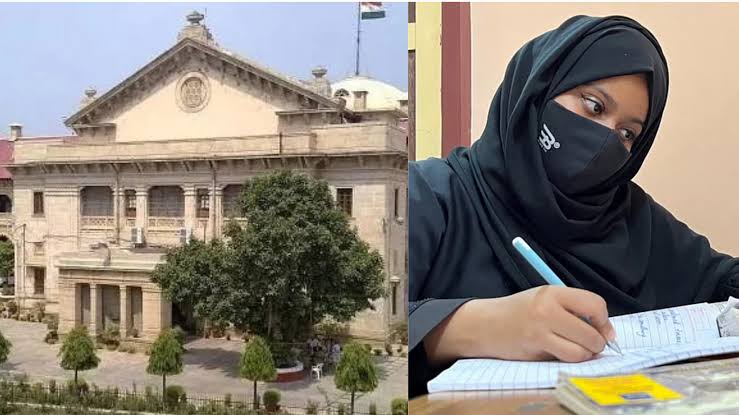
The Allahabad High Court in an order dated 21 August 2026 stated that the practice of wearing hijab or headscarf cannot be demonstrated as the Essential Religious Practice (ERP) under Islam. The case of Sukaina Rizvi v. State of UP and Others was heard by the Division Bench of Justice J.J. Munir and Justice Indrajeet Shukla.
The Petition was filed by a minor student as she wanted to allow the freedom to appear in the school uniform along with the headscarf for seeking admission to class XI.
Key Points
- The petitioner who had completed class X in a private school in Prayagraj claimed to have worn the headscarf since class VI. She sought admission to the class XI with the school uniform but with an exception to allow to wear the headscarf, which the school did not permit in accordance with its dress code.
- The petitioner argued that the practice of wearing hijab was an essential religious practice, which was protected under freedom of religion (Article 25), as well as equality (Article 14) and freedom of speech and expression (Article 19(1)(a)).
- The Bench concluded that there was no sufficient material before it to establish that a Muslim woman would not have been considered to have desisted from Islam if she chose not to wear the headscarf. Hence it cannot be said to be an essential religious practice.
- The Bench added that a private, unaided and non-minority school can impose a uniform dress code without any discrimination to maintain the discipline and its identity.
- While delivering the verdict, the Allahabad Bench cited the 2022 Karnataka High Court Full Bench decision of Resham v. State of Karnataka, which held that the practice of hijab cannot be demonstrated as an Essential Religious Practice under Islam. It said it was persuaded by the reasoning of the said judgment and did not find any reason to depart from the said conclusion.
- The judgment also refers to the Bombay High Court judgment which held that not covering one’s head does not constitute any violation of an essential Islamic practice.
What is Essential Religious Practice (ERP)?
- Essential Religious Practice (ERP) is a legal doctrine developed by Indian courts to determine which practices of a religion receive protection under Article 25 of the Constitution, which guarantees freedom of conscience and the right to profess, practise and propagate religion.
- Under the ERP doctrine, a religious practice is considered essential when it is so fundamental to a religion that removing it would alter the basic character or nature of that religion.
- The judiciary, rather than religious authorities, ultimately determines whether a particular practice qualifies as essential. Courts may examine religious scriptures, doctrines, beliefs and established practices while deciding this question.
Key Features
- Essential practices: Practices considered fundamental to a religion receive constitutional protection.
- Non-essential practices: Practices that are not considered integral to the faith may be regulated by the State.
- Not every religious practice is protected: The fact that a practice is followed by a section of a religious community does not automatically make it an essential religious practice.
- State regulation: A practice that does not satisfy the ERP test may be subject to reasonable and non-discriminatory regulations, including institutional rules.
Origin of the Doctrine
- The doctrine is generally traced to the Supreme Court's 1954 judgment in Commissioner, Hindu Religious Endowments, Madras v. Sri Lakshmindra Thirtha Swamiar of Sri Shirur Mutt.
- In the case, the Supreme Court held that religion under Article 25 includes not only beliefs but also rituals and practices that are integral to the religion. At the same time, secular activities associated with religious practice can be regulated by the State.