Why in News
The recent research conducted by Gujarat Ecological Education and Research (GEER) Foundation has identified Khijadiya Bird Sanctuary in Jamnagar district of Gujarat as an important breeding ground for the Black-necked Stork species.
Key Highlights
- The study revealed that the Khijadiya Bird Sanctuary in Jamnagar, Gujarat has been proved as an optimal breeding habitat for the Black-necked Stork.
- The journal of ‘Journal of Threatened Taxa’, published research work on the status of the population, breeding ecology and nesting habitats of the black-necked stork at Khijadiya between July 2024 and March 2025.
- The researchers have discovered four nests with every breeding pair that has produced two chicks.
- The study further said that each pair of breeding black-necked storks raised two fledglings.
- Besides, the study also stated that the population of these birds reached its maximum level in the sanctuary with 21 individuals, including five non-breeding adults.
- According to research, there was a 100 % fledging success as all the nests observed by the scientists reared young ones to maturity.
Suitable Habitat Conditions
- The research says that suitable shallow water wetlands with depths between 0.3 - 0.7 meters were present near the nest sites that provided nesting birds with diverse prey items like fish, amphibians, crustaceans, and other wetland invertebrates necessary for the survival of both the adults and the offspring.
- The composition of habitat consists of a shallow water area, emergent vegetation, open wetlands, higher ground, nesting trees, and undisturbed feeding zones.
Black-necked Stork Species
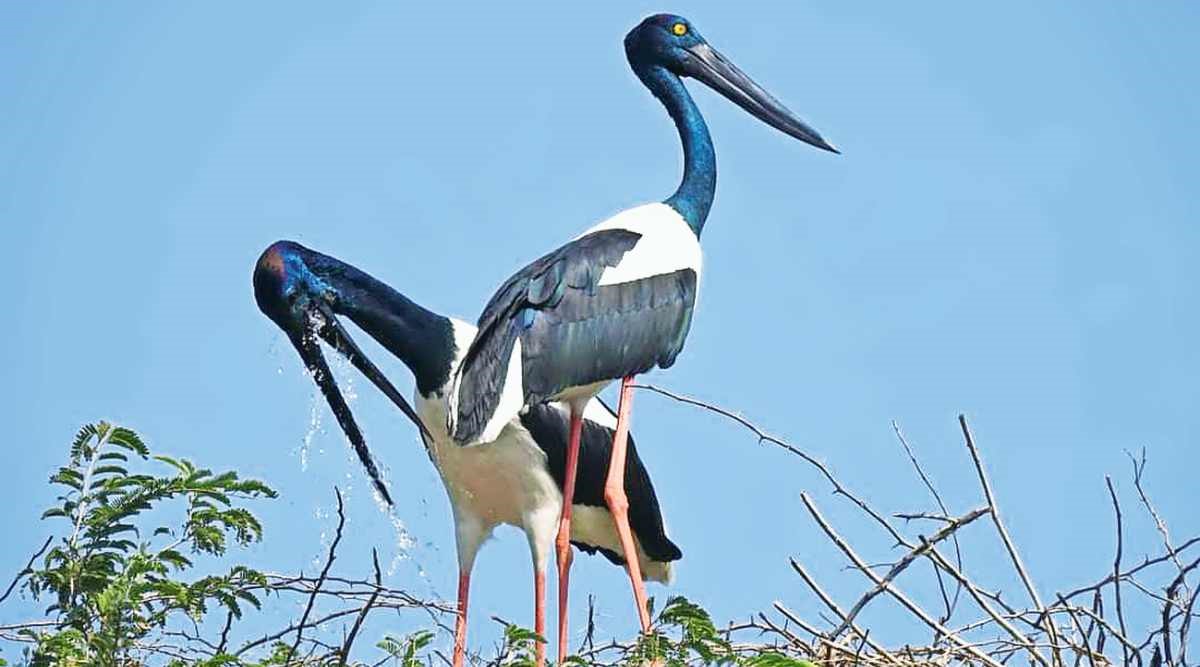
- The black-necked stork is one of the largest wetland birds in India. It is easily recognized by its black and white plumage, long bill, and long legs. It often inhabits wetlands, marshes, flood plains, and shallow water and can be found across the Indian Subcontinent, Southeast Asia, and Australia.
- The black-necked stork (Ephippiorhynchus asiaticus) is a part of the family Ciconiidae.
- The black-necked stork is protected under the Wild Life (Protection) Amendment Act, 2022, and is listed in Schedule II of the Wildlife (Protection) Act, 1972.